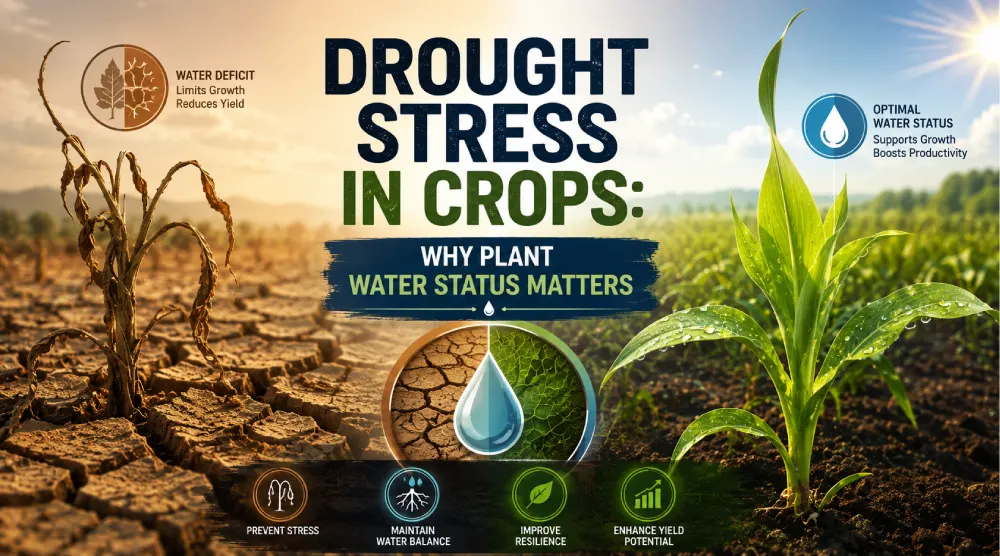
A crop can appear healthy even while water limitation has already begun changing its physiology.
Visible wilting, leaf rolling and premature senescence are useful field indicators of drought stress, but they are not necessarily the first responses. As soil water availability declines, plants begin adjusting water use, gas exchange and cellular metabolism before severe visual symptoms become apparent.
Understanding these early responses is important because successful drought management depends not only on the amount of water present in the soil, but also on how effectively the crop maintains its internal water status and physiological function.
Soil Moisture and Plant Water Status Are Not the Same Thing
Soil moisture tells us how much water is present in the root zone.
Plant water status tells us how the crop is actually responding to that available water.
Useful indicators include:
- Relative Water Content (RWC)
- Leaf water potential
- Stomatal conductance
- Transpiration
- Canopy temperature
Together, these measurements provide information about plant hydration, water loss and the physiological consequences of developing moisture stress.
Two fields with similar soil moisture may therefore show different crop responses depending on rooting depth, soil characteristics, evaporative demand, crop stage and the plant’s ability to access and regulate water.
What Happens When Water Becomes Limited?
One of the earliest responses to declining plant water availability is often a reduction in stomatal conductance.
Stomata regulate both water loss and carbon dioxide entry into the leaf. Closing them helps conserve water, but it also restricts CO₂ uptake and can reduce photosynthetic carbon assimilation.
As drought becomes more severe or prolonged, additional changes may occur, including:
- Declining tissue hydration and Relative Water Content
- Reduced leaf water potential
- Loss of cellular turgor
- Reduced photosynthetic activity
- Changes in membrane integrity
- Increased oxidative pressure
- Reduced leaf expansion and biomass accumulation
Research across a wide range of species shows that drought responses are strongly influenced by stress intensity and duration. Mild water limitation may primarily affect stomatal behavior and carbon assimilation, while more severe drought can produce broader effects on photosynthetic machinery, membranes and cellular metabolism.
Why Canopy Temperature Matters
Transpiration helps cool plant leaves.
When stomatal closure restricts transpiration during water deficit, canopy temperature may rise relative to well-watered plants.
This relationship makes canopy temperature and thermal imaging useful tools for assessing crop water stress when measurements are interpreted together with weather conditions, radiation, humidity, soil moisture and crop architecture.
Canopy Temperature Depression (CTD)—the difference between air and canopy temperature—is one useful field parameter for studying a crop’s ability to maintain transpirational cooling.
It should not, however, be interpreted in isolation.
Relative Water Content: A Direct View of Plant Hydration
Relative Water Content, or RWC, is widely used to assess the hydration status of plant tissues.
Rather than measuring only water availability in the soil, RWC helps indicate how much water leaf tissue retains relative to its fully hydrated condition.
Under drought, plants that maintain relatively higher tissue hydration may be better able to sustain cell turgor and physiological activity than plants showing a rapid decline in water status.
For this reason, RWC is a useful parameter when comparing crop response to moisture deficit.
What About Chlorophyll Fluorescence?
Chlorophyll fluorescence provides useful information about photosynthetic function.
The commonly measured Fv/Fm ratio estimates the maximum quantum efficiency of photosystem II in dark-adapted tissue.
However, Fv/Fm should be interpreted carefully during drought.
Under mild or moderate drought, photosynthesis may decline primarily because stomatal closure limits CO₂ availability while Fv/Fm changes very little. More substantial changes in Fv/Fm are often associated with stronger or prolonged stress affecting photosystem II.
This makes Fv/Fm most useful as part of a broader physiological assessment rather than as a standalone drought indicator.
Membrane Stability and Drought Injury
Water deficit can also affect cellular membranes.
As drought severity increases, oxidative stress and changes in membrane structure can compromise membrane integrity.
Researchers commonly evaluate this through measurements such as electrolyte leakage and membrane stability.
Malondialdehyde (MDA) is also widely used experimentally as an indicator associated with lipid peroxidation and oxidative membrane injury.
These are scientifically useful drought-stress measurements, but they should be interpreted together with plant water status, photosynthetic responses and whole-plant performance.
Roots Still Matter—But They Are Only One Part of Drought Resilience
Root architecture plays an important role in water acquisition.
Rooting depth, root distribution, hydraulic properties and effective root-soil contact can influence how well a crop accesses water during periods of declining soil moisture.
But drought resilience cannot be described by root size alone.
The final response reflects the interaction between water acquisition and water conservation, including:
- Root system function
- Stomatal regulation
- Tissue hydration
- Osmotic adjustment
- Membrane stability
- Photosynthetic performance
- Developmental stage
- Recovery after stress
This is why drought resilience is best evaluated using multiple complementary measurements.
From Water Status to Field Performance
A useful drought-stress evaluation should connect physiological response with whole-plant performance.
Relevant observations may include:
Plant water status
- Relative Water Content
- Leaf water potential
- Stomatal conductance
- Canopy temperature
Physiological integrity
- Membrane stability
- Chlorophyll fluorescence
- Photosynthetic performance
Whole-plant response
- Leaf senescence
- Survival
- Recovery time
- Biomass and growth
Productive response
- Yield under stress
- Yield under non-stress conditions
- Appropriate stress-tolerance and stability indices
No individual parameter proves drought tolerance on its own. The value comes from understanding how these measurements relate to one another.
Stressilient: Supporting Crop Resilience Under Moisture Stress
Within the Upcrop® Technology Platform, Stressilient is designed to support crop resilience under abiotic stress conditions, including periods of moisture stress.
Its technical positioning focuses on supporting osmotic adjustment, membrane stability, antioxidant defense and cellular homeostasis during stressful environmental conditions.
The Stressilient validation framework evaluates crop response using measurable physiological and performance indicators including:
- Relative Water Content (RWC)
- Leaf Senescence Index
- Plant Survival Rate
- Fv/Fm
- Canopy Temperature Depression
- Membrane Stability
- Days to Recovery
- Stress Tolerance Index
- Stress Yield Stability Index
- Stress Susceptibility Index
These parameters provide complementary information about how crops maintain physiological function during stress and how effectively they recover afterward.
Evaluating Drought Performance with Stress Indices
Yield-based indices can help summarize crop performance across stress and non-stress environments.
Stress Tolerance Index — STI
STI considers yield performance under both stress and non-stress conditions and is commonly used to identify entries that combine productive potential with stress performance.
A commonly used formulation is:
STI = (Yp × Ys) / (mean Yp)²
where:
- Yp = yield under non-stress conditions
- Ys = yield under stress conditions
- mean Yp = mean non-stress yield of the comparison population
Yield Stability Index — YSI
YSI is commonly expressed as:
YSI = Ys / Yp
It describes the proportion of potential yield maintained under stress.
Stress Susceptibility Index — SSI
SSI evaluates relative yield reduction under stress while considering the overall intensity of the stress environment.
These indices provide different perspectives and should therefore be interpreted as complementary indicators, not as one universal drought-tolerance score.
They are most useful when combined with statistically sound yield comparisons and relevant physiological measurements.
Why Timing Matters
Drought management should begin before severe visual injury becomes established.
Once prolonged water deficit causes extensive tissue senescence, reproductive failure or irreversible cellular injury, complete recovery of lost productivity may not be possible.
Supporting crop physiological function before anticipated stress, during water limitation and during the recovery phase therefore provides a more rational framework for managing moisture stress.
The objective is not to make crops “drought-proof.”
It is to help crops maintain critical physiological functions, tolerate periods of water limitation more effectively and recover when favorable conditions return.
Measuring Resilience, Not Just Symptoms
Effective drought management requires looking beyond soil moisture alone.
Soil measurements describe the water environment.
Plant measurements reveal how the crop is responding to that environment.
Bringing the two together provides a more complete understanding of crop water stress—and a stronger scientific basis for evaluating biological technologies intended to support crop resilience.
For agricultural biotechnology company inputs, the most credible pathway is:
Stress condition → physiological response → measurable resilience → recovery → productive performance.
That is a much stronger foundation than simply claiming that a product makes crops “drought resistant.”
Also Read:-
- Root-to-Canopy Signal: How Underground Strength Drives Visible Crop Performance
- Heat Stress in Crops: Protecting Plant Performance Before Damage Becomes Visible
More Useful Links:-
Agricultural Biotechnology Company | Organic Fertilizer For Plants | Biostimulant Products In Agriculture