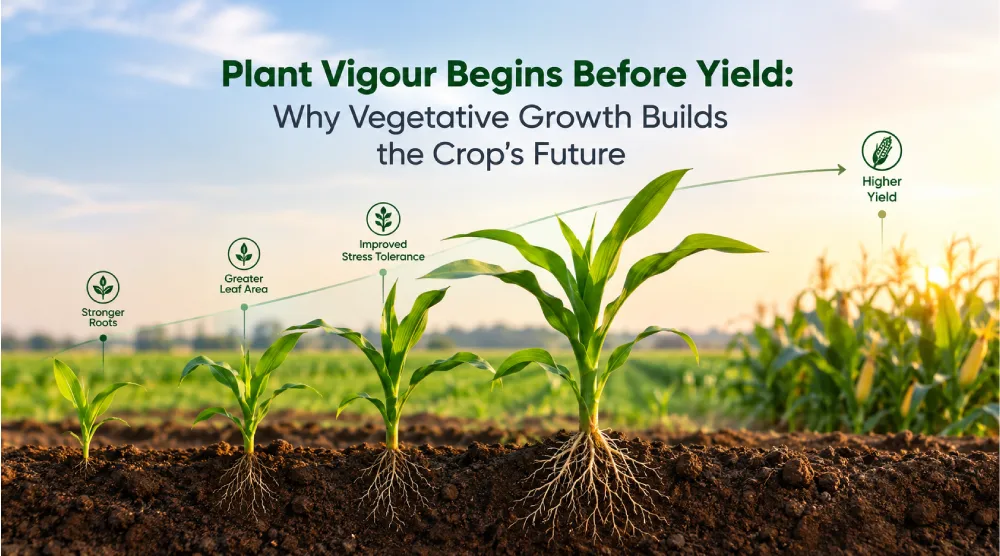
There is a point in every crop cycle when attention naturally shifts towards yield. Flowers begin to appear, reproductive structures become visible, and expectations start to form around fruit number, grain formation, pod development, or harvestable biomass. Yet by the time a crop enters this stage, an important part of the yield story has already been written.
Long before the reproductive phase becomes visible, the plant has been building the biological infrastructure that will support it. Leaves have expanded, stems have developed, branches or tillers have formed, roots have explored the soil, chlorophyll-containing tissues have been established, and biomass has accumulated. The crop has been constructing its photosynthetic and structural capacity during what is sometimes treated simply as the period between establishment and flowering.
This is why plant vigour deserves a more serious place in crop management. Plant vigour is not merely about whether a field looks green. Nor should it be reduced to plant height or rapid visible growth. In a physiological sense, vigour reflects how successfully a plant is building and maintaining the structures and processes required for continued growth. It combines architecture, leaf development, metabolic activity, biomass production, resource acquisition, and the ability to sustain active growth as the crop moves through its developmental stages.
Understanding plant vigour therefore changes the question from “Is the crop growing?” to something much more useful: Is the crop building enough functional capacity for what will be demanded of it later?
Vegetative Growth Is a Construction Phase, Not a Waiting Phase
The vegetative stage is often described simply as the period when leaves and stems develop before flowering. That description is correct, but it understates the importance of what is happening during this period.
During active vegetative growth, a crop continuously converts light, water, carbon dioxide, and mineral nutrients into new biological structure. New leaves expand and increase the surface available for light capture. Stems provide mechanical support and transport pathways. Branches and tillers enlarge the plant’s architecture. Roots continue to develop and interact with the soil environment.
At the cellular level, division, expansion, protein synthesis, membrane activity, nutrient assimilation, and numerous metabolic pathways are operating simultaneously. Together, these processes form an important part of plant growth and development.
A plant that establishes this infrastructure effectively can enter later stages with a larger functional leaf area, stronger shoot architecture, and greater accumulated biomass. A plant that develops slowly or unevenly may still survive and eventually flower, but it may reach that stage with less biological capacity.
The difference may not always be obvious during an initial visual assessment. Two crops can have similar height but different leaf area. Two plants can appear equally green but differ substantially in dry matter accumulation. A visually dense crop may also have a very different canopy architecture from another crop with similar colour.
This is why evaluating vegetative growth in plants requires more than a quick impression from the edge of a field.
Plant Vigour Is More Than Plant Height
Height is one of the easiest characteristics to observe, which is probably why vigorous growth is frequently associated with taller plants. However, height by itself can be misleading.
A plant can become taller because its internodes are extending without producing a proportional increase in leaf area or biomass. Another plant may remain relatively compact while producing more leaves, thicker stems, and a stronger canopy. Depending on the crop, the second plant may have greater functional capacity even though it is shorter.
The same principle applies to colour. Dark-green foliage attracts attention because it creates an immediate impression of crop health. Chlorophyll status is certainly relevant to plant performance, but colour cannot independently describe the whole crop.
Leaf area, structural development, chlorophyll content, photosynthetic behaviour, biomass, and plant uniformity each contribute different information.
Therefore, meaningful plant vigour is better viewed as an integrated expression of plant physiological performance, rather than a single morphological characteristic.
For field evaluation, this can include plant height, leaf number and expansion, stem diameter, branching or tillering, shoot fresh or dry biomass, canopy coverage, chlorophyll-related measurements, and vegetation indices. The importance of each parameter differs between crops, growth stages, and production systems, but the underlying principle remains consistent: vigour should describe functional development, not simply fast elongation.
Where Does Biomass Fit Into the Story?
One of the most informative outcomes of vegetative development is biomass accumulation.
Biomass represents the physical result of numerous physiological processes occurring over time. A plant must capture radiation, exchange gases, acquire water and nutrients, assimilate carbon, synthesise cellular components, and allocate resources into new tissue before biomass can increase.
For this reason, biomass tells a different story from plant height or leaf colour. It reflects what the plant has actually constructed.
Shoot dry biomass is particularly useful in crop research because water content can vary substantially between plants and treatments. Dry matter can therefore provide a more stable indication of accumulated structural and metabolic material.
However, more biomass is not automatically better in every circumstance. Agriculture is not simply an attempt to produce the largest possible vegetative plant. The crop eventually has to distribute resources between vegetative organs and economically important sinks such as fruits, seeds, tubers, roots, or other harvestable structures.
The objective is not uncontrolled vegetative growth. It is appropriately timed, functionally useful biomass accumulation in crops that contributes to the plant’s capacity to support later development.
The Crop Is Creating Its Future Photosynthetic Surface
Leaves are much more than visible signs of growth. Collectively, they create the principal surface through which the crop intercepts light and performs photosynthetic carbon assimilation.
Early leaf expansion can have a compounding effect. As the crop develops a larger effective leaf area, it gains greater potential to intercept incoming radiation. That captured energy can support further growth, additional leaf formation, and biomass production.
But leaf area cannot be considered independently of architecture. Leaves must be positioned within the canopy, and their distribution determines how light penetrates through different layers of the crop.
This means that plant vigour eventually connects with canopy development, photosynthetic capacity, and the crop’s ability to build dry matter.
A vigorous crop is not simply producing more plant tissue. Ideally, it is constructing a functional system in which roots, stems, and leaves work together to support continued development.
Vigour Is Also a Question of Plant Metabolism
Visible plant growth is the final expression of a much less visible biochemical system.
Plants continuously process carbon, nitrogen, and other nutrients through interconnected metabolic pathways. Sugars produced through photosynthesis must be transported and used. Nitrogen must be absorbed, assimilated, and incorporated into amino acids, proteins, chlorophyll, and other compounds. Minerals participate in enzyme activity, osmotic regulation, structural functions, and energy transfer.
This underlying plant metabolism determines whether acquired resources can actually be converted into growth.
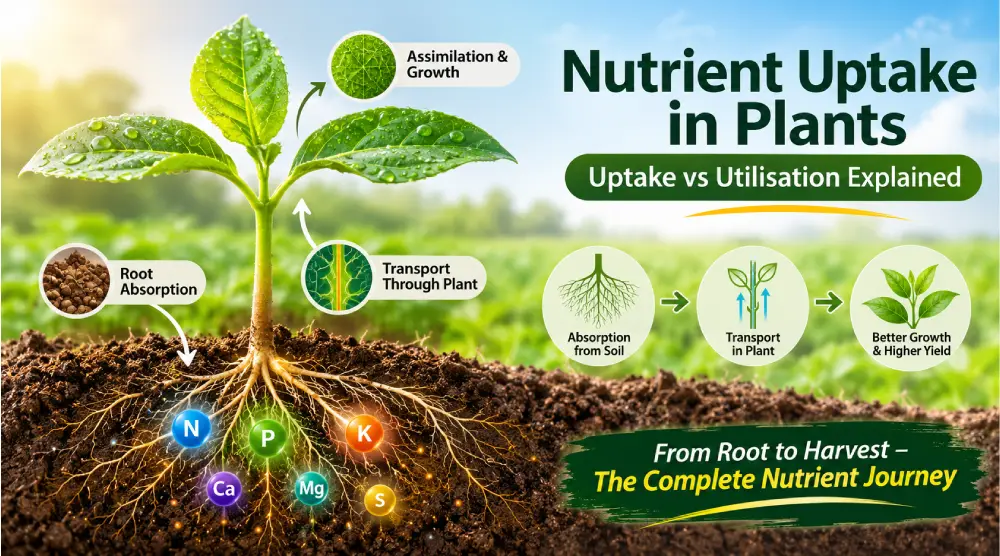
Providing nutrients to the crop is therefore only one part of the process. Nutrients must become available, reach the root zone, be acquired by the plant, transported to the appropriate tissues, and assimilated into useful biological forms.
A crop can consequently experience limitations even where fertilizer has been applied. Soil conditions, root activity, water availability, temperature, nutrient interactions, and physiological status can all affect the efficiency with which resources become productive plant tissue.
This is one reason modern crop nutrition increasingly considers plant physiology alongside nutrient supply.
For broader crop nutrition strategies, biological inputs can be considered alongside conventional nutrient management. Trishul Biotech’s work in agricultural biological technologies includes areas related to crop nutrition and plant performance.
Explore Trishul Biotech’s agricultural solutions
A Vigorous Plant Is Not Necessarily an Excessively Vegetative Plant
The word “vigour” can sometimes create the wrong agronomic picture: a very tall, lush, dark-green crop producing excessive vegetative tissue at the expense of reproductive development.
That is not the objective.
Good crop vigour is better understood as balanced physiological development appropriate to the crop and growth stage.
In cereals, this may involve productive tiller formation, adequate leaf area, and strong biomass development without creating excessive lodging risk. Fruiting vegetables require sufficient canopy development to capture light and support developing reproductive sinks, while excessive vegetative growth can cause shading and alter source-sink relationships.
In perennial fruit crops, canopy architecture must also remain compatible with light distribution, fruiting structure, and management practices.
The ideal plant architecture therefore depends on the production system.
Plant vigour should not be managed as “more growth at any cost.” Its agronomic value lies in helping the crop establish the physiological and structural foundation appropriate for later productivity.
The Hidden Cost of an Under-Built Crop
Poor crop vigour does not always appear as severe stunting.
Sometimes the field simply develops slightly less leaf area than expected. Branching may be weaker. Stem development may be slower. Biomass may accumulate gradually. Plant-to-plant variation may increase, while chlorophyll-related measurements begin to diverge.
Each difference may appear small when considered independently.
Together, however, they can reduce the effective photosynthetic surface available to the crop.
An under-developed canopy may intercept less radiation during important growth periods. Reduced photosynthetic surface can influence carbon assimilation and subsequent biomass production. Less-developed plants may enter flowering or reproductive development with reduced capacity to supply rapidly growing sinks.
This does not mean vegetative measurements can be directly converted into a guaranteed yield response. Crop productivity is influenced by numerous later factors, including reproductive success, stress exposure, nutrient availability, water management, pests, diseases, and harvest conditions.
It does mean that yield potential is developed progressively, rather than suddenly created at harvest.
The biological condition in which the crop enters its reproductive stage matters.
Plant Vigour Should Be Followed as a Trajectory
A single measurement can tell us where a crop is on one particular day. Several measurements across time can tell us where it is going.
This distinction is important.
Imagine two fields with plants averaging the same height at 30 days. If the first field reached that height after steady development while the second experienced an early delay followed by rapid elongation, their developmental histories are different.
Likewise, a single SPAD measurement cannot describe the crop’s entire chlorophyll trajectory. One biomass measurement cannot tell whether biomass accumulated steadily or only recently. One NDVI observation cannot capture how quickly canopy closure occurred.
Agronomic interpretation becomes stronger when plant performance is evaluated across developmental time.
Changes in leaf area, biomass, plant height, chlorophyll status, and canopy indicators can reveal whether the crop is maintaining momentum or beginning to lose physiological capacity.
This is particularly relevant when evaluating a crop growth biostimulant. The question should not simply be whether a treated crop appears larger on one observation date. More useful questions include whether development becomes more consistent, whether leaf-area formation is sustained, whether biomass accumulation is improved, and whether the crop maintains physiological activity through the intended growth window.
Crop Productivity Starts With Biological Capacity
The relationship between vegetative growth and final productivity is not perfectly linear. A plant with twice as much vegetative biomass will not automatically produce twice the yield.
Yet the reproductive plant cannot operate independently of the vegetative plant that preceded it.
Developing flowers, fruits, grains, pods, and other sinks rely on resources supplied through the plant. Leaves provide photosynthates. Roots continue to provide water and mineral nutrients. Vascular tissues transport resources between source and sink organs.
A well-developed vegetative system therefore contributes to the crop’s capacity to support later demand.
That is the more useful connection between plant vigour and crop productivity.
Instead of claiming that vigorous vegetative growth directly produces yield, it is scientifically stronger to say that well-managed vegetative development helps build the physiological foundation associated with later productive performance.
Where Biological Inputs Can Fit
Modern crop programs increasingly combine mineral nutrition, water management, genetics, and crop protection with biological technologies designed to influence plant nutrition processes or physiological performance.
Plant biostimulants are particularly relevant in this context because their intended role is not simply to supply conventional fertilizer nutrients. Their application is generally associated with supporting plant nutrition processes and functions such as nutrient-use efficiency, abiotic-stress tolerance, quality-related traits, or nutrient availability.
For vegetative-stage applications, practical interest lies in whether a biological input can contribute to measurable aspects of plant growth and development, such as leaf formation, canopy establishment, chlorophyll-related performance, biomass accumulation, or other crop-specific indicators.
Biological inputs derived from marine algae are also being investigated for their potential role in influencing crop growth and physiological processes. However, responses can depend on the biological source, extraction process, formulation, application method, crop, and environmental conditions.
This variability is exactly why good biostimulant development requires more than an attractive ingredient story. Biological characterisation needs to be connected with measurable crop responses.
For more information on Trishul Biotech’s biostimulant-focused work:
Explore Biostimulant Solutions
Seaweed Biostimulants and Crop Growth
Interest in a seaweed biostimulant for crops has grown alongside broader research into biological approaches to crop management.
Seaweed-derived formulations can contain complex biological fractions, and their potential effects may involve several aspects of plant physiology rather than functioning like a conventional single-nutrient fertilizer. This makes formulation quality, biological characterisation, application timing, crop response, and field conditions important considerations.
For vegetative development, the relevant question is not simply whether a seaweed-based input makes a plant appear greener or taller. A more useful evaluation considers measurable parameters such as leaf development, canopy formation, plant vigour, biomass accumulation, and physiological performance.
This approach keeps the discussion focused on biological response rather than relying only on visual observations.
Trishul Biotech develops seaweed-derived agricultural biological inputs and plant biostimulant technologies with applications related to crop nutrition, nutrient-use efficiency, root development, abiotic-stress resilience, and crop quality.
From “Green Crop” to Functional Crop
Plant vigour is most useful when it changes how we observe the field.
Instead of asking only whether the crop looks healthy, we begin asking whether its biological infrastructure is developing appropriately.
- Is leaf area expanding at the expected rate?
- Is the crop accumulating useful biomass?
- Is stem and branch architecture progressing consistently?
- Is chlorophyll status being maintained?
- Is the canopy becoming capable of capturing available light?
- Is plant development sufficiently uniform?
These questions transform crop vigour from a visual description into a physiological concept.
They also create a better way to evaluate a crop growth biostimulant. A biological input should not be judged by an isolated cosmetic response. It should be evaluated against plant parameters that relate meaningfully to its intended function.
Ultimately, the vegetative stage is not merely something the crop has to pass through before the “important” reproductive stage begins. It is when the plant builds much of the machinery that the reproductive stage will later use.
Yield is harvested later. Biological capacity is built earlier.
At Trishul Biotech, this plant-performance perspective guides the development of agricultural biological technologies. The company develops and manufactures seaweed-derived agricultural biological inputs and plant biostimulant technologies for crop nutrition, nutrient-use efficiency, root development, abiotic-stress resilience, and crop-quality management.
Within vegetative crop management, Rhodophyte-derived liquid biological formulations represent one area of development aimed at supporting crop vigour, canopy formation, and plant physiological performance while remaining connected to measurable agronomic responses.
Also Read:-
Salinity Stress in Plants: How to Detect and Manage Crop Stress Before Visible Damage
Salinity Stress in Crops: Understanding the Osmotic and Ionic Challenge
More Useful Links:-
Agricultural Biotechnology Company | Organic Fertilizer For Plants | Biostimulant Products In Agriculture


One thought on “Plant Vigour Begins Before Yield: Why Vegetative Growth Builds the Crop’s Future”
Comments are closed.