Soil salinity challenges crops in more than one way.
Elevated concentrations of soluble salts first change the water relations between soil and plant, making water more difficult for roots to acquire. With continued exposure, ions such as sodium and chloride can accumulate in plant tissues and interfere with nutrient balance, cellular metabolism and photosynthetic function.
Understanding these different components is important because managing the salinity of the soil and understanding how the plant is responding to that salinity are not the same thing. This distinction is central to salinity stress in crops and plant salinity stress management.
One Salinity Problem, Multiple Physiological Effects
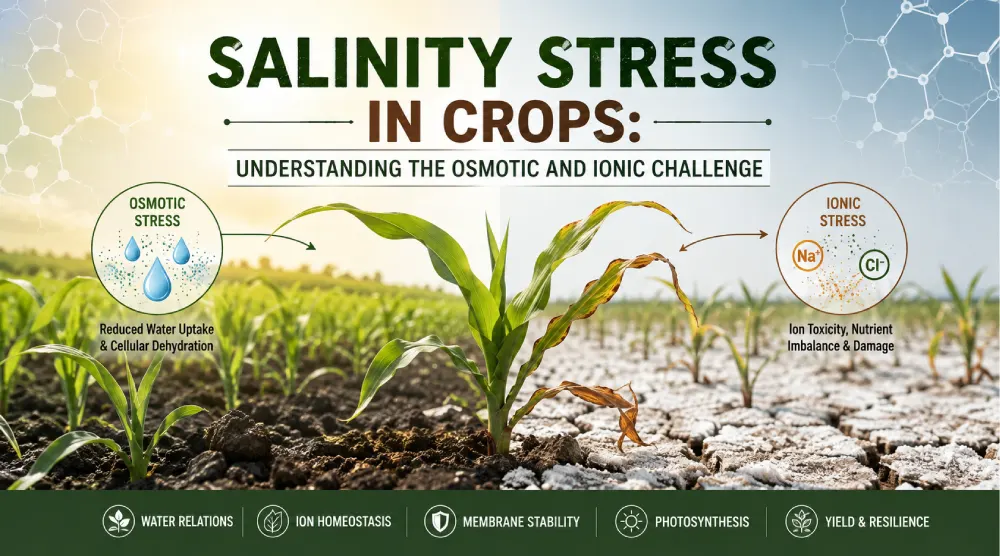
Plant responses to salinity are commonly described through two interacting components: osmotic stress and ionic stress.
Osmotic stress
As salt concentration increases in the soil solution, its water potential declines.
This makes water uptake more difficult for the plant even when the soil itself still contains moisture. This process is an important component of osmotic stress in plants.
The crop may respond by reducing stomatal conductance and growth while adjusting its internal water relations to conserve water and maintain cellular hydration.
Ionic stress
With prolonged exposure, sodium and chloride may accumulate in plant tissues.
Excessive accumulation can interfere with ion homeostasis, nutrient balance and cellular metabolism. The relative importance of sodium and chloride varies among crop species and growing conditions.
Salinity tolerance therefore involves more than simply continuing to absorb water.
Plants must simultaneously regulate water relations and maintain suitable ionic conditions inside their tissues.
Why Na⁺ and K⁺ Matter
Potassium is essential for numerous physiological and enzymatic processes in plants.
Under saline conditions, excessive sodium can interfere with potassium uptake, transport and cellular function.
For this reason, maintaining appropriate K⁺/Na⁺ homeostasis is an important component of salinity tolerance in many crops.
Researchers commonly measure sodium and potassium concentrations in roots or shoots to understand how effectively plants are regulating ionic balance.
However, tissue Na⁺/K⁺ balance should be considered one part of a broader salinity-response assessment rather than a standalone measure of tolerance.
Salinity Also Creates Secondary Oxidative Pressure
Osmotic and ionic stress can disturb cellular metabolism and increase the production of reactive oxygen species.
At controlled concentrations, ROS participate in normal cellular signaling. Under severe or prolonged stress, however, excessive ROS can contribute to oxidative damage affecting membranes, proteins, pigments and other cellular structures.
Plants respond through antioxidant systems and other protective mechanisms.
Researchers may therefore use measurements such as antioxidant enzyme activity, lipid-peroxidation indicators such as MDA, or electrolyte leakage when investigating the cellular effects of salinity.
These measurements are scientifically useful indicators of stress physiology, but they should be interpreted together with water status, photosynthetic performance, growth and yield.
Photosynthesis Under Salinity
Photosynthesis can be affected at several levels during salinity stress in plants.
The osmotic component may reduce stomatal conductance and CO₂ availability, while prolonged ionic and oxidative stress can affect chloroplast function and photosynthetic metabolism.
Chlorophyll content and chlorophyll-fluorescence measurements can therefore contribute to evaluating the photosynthetic response.
One commonly used fluorescence parameter is Fv/Fm, which estimates the maximum quantum efficiency of photosystem II in dark-adapted tissue.
A decline in Fv/Fm can indicate that stress has begun to affect PSII function. However, it should not be assumed that Fv/Fm will decline under every level of salinity, and it is most useful when interpreted alongside other physiological measurements.
Water Status and Canopy Temperature
Because salinity imposes an osmotic constraint on water uptake, plant water relations are an important part of salt-stress in plants assessment.
Relative Water Content (RWC) can provide information about tissue hydration.
Canopy temperature can provide another perspective.
When osmotic stress restricts stomatal conductance and transpiration, the crop’s capacity for transpirational cooling may decline. Measurements such as Canopy Temperature Depression (CTD) can therefore help characterize crop response under defined stress conditions.
Canopy temperature is influenced by many environmental variables and should not be used alone to diagnose salinity.
Moving from Cellular Response to Crop Performance
No single measurement demonstrates salinity tolerance.
A more useful evaluation links several levels of response:
Stress environment
→ salinity or EC challenge
Plant physiological response
→ water status, photosynthetic function and membrane integrity
Whole-plant response
→ senescence, survival and recovery
Productive response
→ yield performance and appropriate stress indices
This distinction matters commercially.
An EC reading describes the environment surrounding the roots. Physiological and agronomic measurements describe how the crop actually responds to that environment.
Stressilient: Supporting Crop Resilience Under Abiotic Stress
Within the Upcrop® Technology Platform, Stressilient is designed to support crop resilience under abiotic stress conditions.
Its technical approach focuses on supporting physiological processes associated with osmotic adjustment, membrane stability, antioxidant defense and cellular homeostasis during periods of environmental stress.
Stressilient performance is evaluated through complementary physiological and whole-plant parameters including:
- Relative Water Content
- Membrane Stability
- Fv/Fm
- Canopy Temperature Depression
- Leaf Senescence Index
- Survival Rate
- Recovery after stress
- Stress Tolerance Index
- Stress Yield Stability Index
- Stress Susceptibility Index
Together, these parameters help build a measurable picture of how the crop performs during stress and how effectively it recovers afterward.
The objective is not to claim that Stressilient removes salts from the soil or lowers soil EC.
Its positioning is instead centered on supporting plant performance under defined abiotic-stress conditions.
That distinction is important.
Managing the salinity of the soil and supporting the physiological resilience of the crop are different agronomic functions.
Measuring Yield Stability Under Stress
Physiological measurements explain what happens inside the crop, but productive performance remains an important endpoint.
Stress indices can help compare crop performance under stressed and non-stressed conditions.
Stress Tolerance Index — STI
STI considers performance under both stress and non-stress environments and can help identify treatments or genotypes combining productive potential with stress performance.
Yield Stability Index — YSI
YSI compares yield under stress with yield potential under non-stress conditions.
Stress Susceptibility Index — SSI
SSI provides an indication of relative yield sensitivity to stress while accounting for overall stress intensity.
These indices describe different aspects of stress performance.
They should therefore be treated as complementary measurements, not compressed into a single universal “salinity-tolerance score.”
A Better Way to Think About Salinity Management
Salinity management begins with understanding the soil environment, but it should not end there.
Soil EC provides essential information about salinity pressure.
Plant measurements reveal the biological consequence of that pressure.
A crop’s response can involve:
- osmotic adjustment,
- regulation of water loss,
- maintenance of ion homeostasis,
- protection of membrane and photosynthetic function,
- control of premature senescence,
- survival during stress, and
- recovery when conditions improve.
This is why credible salinity-resilience programs should distinguish between changing the soil’s salt status and supporting how the plant functions while experiencing salt stress.
For biostimulant products for agriculture inputs, the scientifically defensible pathway is:
Defined salinity stress → measurable physiological response → whole-plant resilience → recovery → productive performance.
That framework provides a stronger foundation than broad claims such as “removes salt,” “neutralizes salinity,” or “makes crops salt-proof.”
Also Read:-
- Drought Stress in Crops: Why Plant Water Status Matters
- Heat Stress in Crops: Protecting Plant Performance Before Damage Becomes Visible
More Useful Links:-
Agricultural Biotechnology Company | Organic Fertilizer For Plants | Biostimulant Products In Agriculture