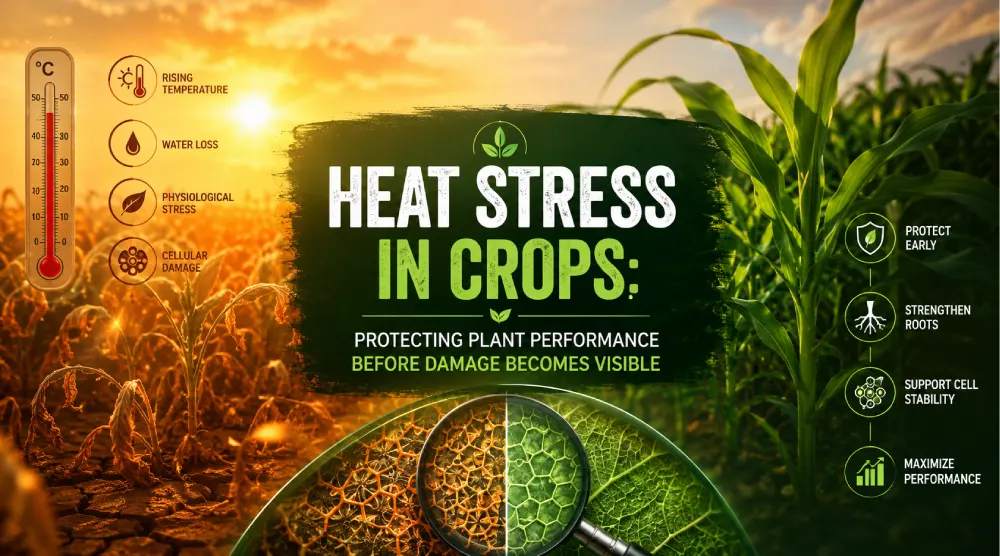
By the time heat stress becomes visible in the field, important physiological changes may already be underway inside the plant.
Wilting, leaf scorching, premature senescence, and canopy decline are familiar signs of heat injury. But these visible symptoms represent only part of the story. Plants begin responding to elevated temperatures at the cellular and physiological level well before severe external symptoms become apparent.
For growers and agricultural input companies, understanding these early responses is important because crop performance under heat depends not only on avoiding visible injury, but also on maintaining physiological function during stress and recovering effectively once temperatures return to favourable levels.
What Happens Inside a Plant During Heat Stress?
When temperatures exceed the optimum range for a crop, several physiological processes can be affected simultaneously.
Cell membranes can become less stable, proteins and enzymes may lose functional efficiency, and the production of reactive oxygen species (ROS) can increase. When ROS production exceeds the plant’s antioxidant capacity, oxidative damage can affect membranes, proteins, pigments, and other cellular components.
Photosynthesis is also particularly sensitive to excessive temperature. Heat can affect photosystem II activity, chlorophyll stability, carbon assimilation, and stomatal regulation.
The plant therefore faces a difficult balancing act: maintaining photosynthesis and transpirational cooling while conserving sufficient water to sustain cellular function.
Reproductive development can be even more vulnerable. In many crops, flowering, pollen development, pollen viability, germination, fertilization, and early fruit or grain set are among the processes most sensitive to elevated temperatures.
This is why a relatively short heat event during a critical reproductive stage can sometimes have consequences that become apparent only later as reduced fruit set, grain number, yield, or crop uniformity.
Plants Have Their Own Heat-Defense Systems
Plants are not passive during a heat event.
Exposure to elevated temperature activates a coordinated stress response involving heat-shock proteins, antioxidant defense systems, osmotic adjustment, membrane protection, and changes in stomatal regulation.
Heat-shock proteins help maintain protein function and assist with the stabilization or refolding of heat-affected proteins. Antioxidant systems help regulate excessive ROS, while compatible osmolytes and other protective metabolites contribute to cellular homeostasis.
The effectiveness of these responses depends on crop species, genotype, developmental stage, stress intensity and duration, water availability, and the plant’s physiological condition before the stress event.
For this reason, heat tolerance cannot be judged from a single visible characteristic.
Measuring Heat Stress Before Yield Tells the Story
A stronger assessment of crop resilience combines physiological measurements with whole-plant performance.
Relative Water Content (RWC) provides an indication of plant water status and the ability of tissues to maintain hydration during stress.
Membrane stability provides insight into the integrity of cellular membranes under stressful conditions.
Chlorophyll fluorescence, including Fv/Fm, can be used to evaluate the maximum quantum efficiency of photosystem II and identify changes in photosynthetic function associated with stress.
Canopy Temperature Depression (CTD) provides information about the relationship between canopy and ambient temperature. Under appropriate environmental conditions, the ability to maintain a cooler canopy can reflect effective transpirational cooling and plant water status.
At the whole-plant level, leaf senescence, plant survival, recovery time, and subsequent growth and productivity provide additional evidence of how effectively a crop tolerated and recovered from the stress event.
No single measurement tells the complete story. Together, these physiological and agronomic indicators provide a more meaningful picture of crop resilience.
From Stress Response to Yield Stability
Ultimately, successful stress management should be evaluated not only by how a plant looks during stress, but by how well it maintains function, recovers, and preserves productive potential.
Yield-based stress indices can help quantify this response.
The Stress Tolerance Index (STI) is commonly used to compare performance under stress and non-stress conditions while considering yield potential.
Other indices, including Yield Stability Index (YSI) and Stress Susceptibility Index (SSI), can provide complementary information about yield stability and sensitivity to stress.
These indices should not replace physiological measurements or statistical analysis of trial results. Instead, they provide additional tools for translating complex stress responses into commercially meaningful measures of crop performance.
Stressilient®: Supporting Crops Through Abiotic Stress
Within the Upcrop® Technology Platform, Stressilient® is designed to support crop resilience under abiotic stress conditions.
Its technical approach focuses on supporting membrane stability, osmotic adjustment, antioxidant defense, and cellular homeostasis during periods of environmental stress.
The Stressilient validation framework examines crop response across multiple physiological and performance indicators, including:
- Relative Water Content (RWC)
- Leaf Senescence Index
- Plant Survival Rate
- Membrane Stability
- Fv/Fm
- Canopy Temperature Depression
- Days to Recovery
- Stress Tolerance Index
- Stress Yield Stability Index
- Stress Susceptibility Index
Together, these parameters provide a structured way to evaluate how crops maintain physiological function during stress and how effectively they recover afterward.
Why Timing Matters
Abiotic stress management is not simply about responding after visible damage appears.
Once severe cellular injury, reproductive failure, or tissue senescence has occurred, the opportunity for complete recovery may be limited. Supporting crop physiological resilience before anticipated stress, during stress exposure, and through the recovery period therefore provides a more rational approach to stress-management programs.
This is particularly important around sensitive crop stages such as reproductive bud development, flowering, fruit set, and other periods when environmental stress can strongly influence subsequent productivity.
Building Resilience That Can Be Measured
Climate resilience should mean more than a crop that simply remains green after a stressful week.
A resilient crop should demonstrate an ability to maintain critical physiological functions during stress, limit cellular injury, recover efficiently when favorable conditions return, and preserve productive potential.
For agricultural biological inputs, this also changes how stress-management technologies should be evaluated.
Rather than relying only on broad “anti-stress” claims, credible product positioning should connect mechanism → measurable physiological response → whole-plant recovery → productive performance.
That evidence-based approach provides growers, agronomists, formulators, and distributors with something far more useful than a claim:
a measurable framework for understanding crop resilience.
Also Read:-
- Root-to-Canopy Signal: How Underground Strength Drives Visible Crop Performance
- Stop Selling Rooting. Start Selling Establishment Performance
More Useful Links:-
Agricultural Biotechnology Company | Organic Fertilizer For Plants |Biostimulant Products In Agriculture