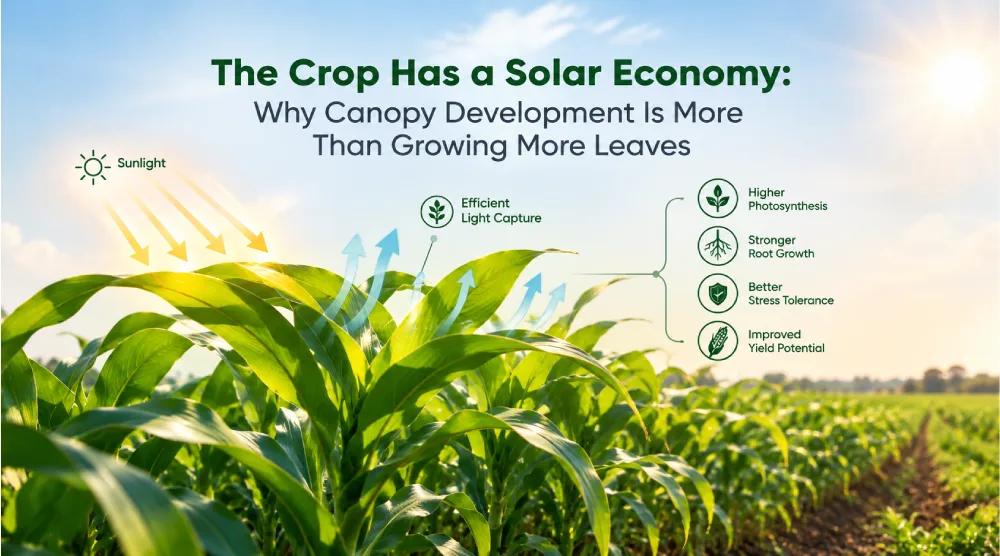
Look across a well-established crop field and the canopy can appear almost continuous. From above, thousands or even millions of individual leaves become a single green surface. It is tempting to think of that surface simply as evidence that the crop has grown well.
Physiologically, something much more interesting is happening.
The canopy is the crop’s interface with sunlight. It is a three-dimensional biological structure that continuously intercepts radiation, exchanges gases, loses water through transpiration, influences its internal temperature environment and produces carbon compounds that are used to build new tissues.
This makes canopy development one of the central processes connecting early vegetative growth with later crop performance.
A productive canopy is not necessarily the canopy with the greatest possible number of leaves. Nor is the darkest or tallest canopy automatically the most effective. What matters is how much functional leaf area the crop develops, how that foliage is distributed through space, how efficiently light penetrates through the canopy and how long the leaves remain physiologically useful.
In other words, canopy performance depends on architecture as much as abundance.
What Is Canopy Development and Why Does It Matter?
Every crop receives light, but not every crop captures it equally.
Sunlight reaching an agricultural field represents an enormous energy input, but plants can use only the radiation intercepted by photosynthetically active tissues.
When a crop is young, much of the incoming radiation reaches the soil surface because the canopy is still open. As leaves expand and plants begin occupying the available space, interception increases. Depending on the crop and management system, a large proportion of incident radiation may eventually be intercepted by foliage.
This progression is one reason early plant growth and development matters so much.
A crop that builds leaf area efficiently can begin capturing a greater fraction of available light earlier in its development. That does not automatically guarantee higher yield, but it changes the amount of energy potentially available to support photosynthesis and biomass production.
At field scale, therefore, one of the most useful questions is not simply whether sunlight is available. Sunlight is almost always available during daylight.
The more useful question is: What proportion of that light is the crop biologically equipped to intercept and use?
That is a canopy question.
Leaf Area Creates Opportunity
The amount of foliage produced by a crop can be expressed in several ways. One of the best known is Leaf Area Index (LAI), which relates leaf area to the ground area occupied by the crop. LAI is widely used to describe vegetation structure and canopy development.
During early crop establishment, increasing leaf area generally improves radiation interception because previously exposed ground becomes occupied by photosynthetically active tissue.
But there is an important point where the simple logic of “more leaves equals better crop” begins to fail.
Leaves are not arranged beside each other on a flat board. They occupy multiple layers.
As the canopy becomes denser, upper leaves intercept a greater proportion of incoming radiation, while deeper leaves receive progressively less. Leaf angle, spacing, orientation, branching pattern and overall plant architecture influence this distribution.
The efficiency of canopy development therefore depends not only on how much leaf area exists, but where that leaf area is located.
A crop with slightly less total leaf area but better foliage distribution can sometimes create a more useful internal light environment than a highly crowded canopy where substantial leaf tissue remains heavily shaded.
This is why canopy architecture deserves attention alongside total canopy size.
How Does Canopy Architecture Affect Photosynthetic Efficiency?
Canopy Architecture: What’s Happening Beneath the Upper Leaves
The upper canopy is where most people judge crop vigor because it is what we can see from outside the field.
The internal canopy experiences a different environment.
Radiation falls as light passes through successive layers of foliage. Spectral quality changes as wavelengths are absorbed or reflected by leaves. Humidity can be greater within dense plant stands, air movement can decrease, and leaf temperature and transpiration conditions can vary with position.
The plant therefore does not operate as a uniform green surface.
Different leaves can experience very different photosynthetic environments even while belonging to the same plant.
Upper leaves may receive strong irradiance and operate close to their light-saturated photosynthetic range during parts of the day. Lower leaves may function under much lower light. Some interior foliage may contribute positively to whole-plant carbon balance, while excessively shaded leaves can become progressively less productive as the canopy matures.
Canopy architecture influences how effectively this limited resource — light — is distributed.
That makes architecture part of photosynthetic efficiency at crop scale.
Photosynthetic Capacity Is Not Only a Leaf Property
Photosynthesis is often discussed at the level of an individual leaf. Researchers measure gas exchange, chlorophyll fluorescence or pigment status and use these observations to understand leaf physiology.
Crop production, however, operates at canopy scale.
A leaf may have excellent photosynthetic performance, but if the crop produces too little leaf area, total radiation interception can remain limited. Conversely, a crop can produce enormous leaf area but distribute it inefficiently, creating substantial internal shading.
Whole-crop photosynthetic capacity, and by extension photosynthetic efficiency at field scale, therefore emerges from both leaf-level physiology and canopy-level structure.
This is a useful distinction for agronomy and biological-input evaluation.
Improving chlorophyll-related performance without adequate leaf area addresses one component. Increasing leaf area without maintaining leaf function addresses another. Creating taller plants without improving canopy architecture may contribute little.
When multiple improvements occur together — useful leaf expansion, maintained chlorophyll status, stronger physiological activity and appropriate canopy structure — the biological response becomes more meaningful.
This is the difference between simply growing leaves and building a functioning photosynthetic system.
Biomass Is Where Captured Energy Becomes Plant Structure
Radiation interception alone does not create biomass. The plant must convert captured light into chemical energy through photosynthesis, assimilate carbon and allocate that carbon into new tissues.
This is where canopy development connects directly with biomass accumulation.
Leaves, stems, roots and eventually reproductive structures all represent accumulated biological material. Their development depends on carbon assimilation together with water, nutrient acquisition and metabolic processes.
A rapidly developing canopy can therefore create a positive feedback during vegetative growth. More functional leaf area allows greater potential light interception, which can support further carbon assimilation and tissue development, which in turn creates additional leaf area.
However, this relationship operates within biological limits.
As canopies become dense, additional foliage produces diminishing returns because new leaves increasingly overlap existing ones. Internal shading increases and the marginal contribution of additional leaf area can decline.
The objective should therefore not be “maximum biomass” or “maximum LAI” without context.
The better objective is functional biomass arranged in a productive architecture.
Crop Vigor Has a Spatial Dimension
When agronomists speak about crop vigor, the discussion usually focuses on how quickly plants are growing.
Canopy development adds another dimension: where that growth is occurring.
Is plant height increasing mainly through internodal extension? At the same time, does tillering create useful additional foliage? Another consideration is whether the crop is closing gaps between plants evenly.
This spatial interpretation matters because fields are populations, not isolated individual plants.
One exceptionally vigorous plant cannot compensate perfectly for several poorly developed neighbours. A field with highly variable plant size can leave portions of soil exposed while other areas become excessively crowded.
Uniformity therefore becomes part of canopy performance.
Crop management should ideally produce a population that occupies available space efficiently while avoiding unnecessary competition between adjacent plants.
When Canopy Development Becomes Excessive
Dense green crops are visually impressive, but excess canopy can create its own agronomic challenges.
Heavy foliage can cause severe internal shading. In some production systems, greater canopy humidity can favour certain disease environments. Dense vegetative growth may make spray penetration more difficult. Excessive allocation of resources into shoots can sometimes occur at the expense of reproductive balance.
This is especially relevant when discussing a crop growth biostimulant.
The objective should never be reduced to “produces more leaves.”
Instead, biological support for the vegetative phase should be evaluated against the intended crop architecture. The ideal response may involve leaf expansion, stronger stem development, improved branching, greater biomass or better physiological performance, but the combination and magnitude appropriate for one crop can differ significantly from another.
Biostimulant efficacy therefore needs crop context.
A field crop, orchard, protected vegetable crop and perennial plantation do not share a single ideal canopy.
For broader context on biological inputs, Trishul Biotech’s work in agricultural biostimulants can be explored through its biostimulant technology portfolio.
Canopy Development Changes Through the Season
The canopy is not a permanent structure created once during vegetative growth.
It is continuously changing.
New leaves emerge. Existing leaves expand. Older leaves age. Branches extend. Tillers appear or cease developing. Reproductive structures emerge and begin competing for photoassimilates. Environmental stresses alter growth rates. Nutrient availability changes. Water status influences leaf expansion and stomatal behaviour.
The result is a moving biological system.
Early in the crop cycle, rapid canopy expansion may be desirable because the crop needs to occupy space and intercept increasing amounts of radiation. During the middle vegetative stage, architecture and biomass formation become increasingly important. Later, maintaining sufficient functional leaf area can become critical as reproductive sinks increase their demand for carbohydrates.
This is why measuring canopy development at one date provides only part of the picture.
Its trajectory is often more informative.
How quickly did the canopy develop? When did it approach maximum coverage? Did physiological activity remain stable? Another key consideration is whether leaf senescence began earlier or later. It is also important to assess whether plant-to-plant uniformity improved or deteriorated.
These questions bring plant physiological performance into the canopy conversation.
Chlorophyll Gives Colour to the System, Not the Entire Explanation
Healthy canopy development is commonly associated with green foliage because chlorophyll pigments are central to light absorption in photosynthesis.
Chlorophyll content is therefore an important physiological parameter.
Yet colour cannot tell us the complete story.
A crop may maintain high chlorophyll status while producing limited leaf area. Another may produce substantial canopy biomass but experience reduced leaf-level photosynthetic performance. A third may exhibit high NDVI because of dense vegetation even when further increases in biomass are becoming difficult to distinguish spectrally.
Each measurement sees a different aspect of the system.
SPAD meters provide rapid optical readings related to chlorophyll status, but the relationship between SPAD values and absolute chlorophyll concentration varies among species and can be non-linear.
NDVI provides useful information about vegetation greenness, relative density and condition at canopy scale, but it has limitations. The U.S. Geological Survey notes that NDVI tends to saturate over dense vegetation and is sensitive to underlying soil colour.
This reinforces a broader principle: no single sensor should be expected to describe the entire canopy.
A Better Way to Read the Crop
Imagine assessing two fields midway through vegetative development.
The first field has relatively tall plants and dark-green upper leaves, but moderate leaf area, limited branching and uneven coverage.
The second field is slightly shorter, yet has broader leaf expansion, stronger stem development, greater biomass and more uniform canopy closure.
Which crop has greater vigor?
The answer cannot come from plant height alone.
Now imagine both crops have similar NDVI.
Again, we still do not have the complete answer.
Understanding canopy performance requires several biological perspectives: morphology, physiology, architecture and temporal development.
The more these measurements converge on the same conclusion, the more confidence we can have in the interpretation.
This concept is particularly important for evaluating biological products. A response supported simultaneously by leaf-area development, biomass accumulation, chlorophyll-related status and canopy-level measurements provides a richer physiological story than a change in one isolated parameter.
Can Better Canopy Development Support Yield Potential?
Reproductive growth creates substantial sink demand.
Fruits, grains, seeds, pods and other harvestable organs require assimilates. The strength and activity of these sinks differ among crops and growth stages, but they ultimately depend on the plant’s ability to acquire and distribute resources.
A functional canopy contributes to this source capacity.
It would be too simplistic to claim that increasing LAI or chlorophyll automatically increases yield. Crop yield is affected by reproductive biology, genotype, environment, nutrient supply, water availability, plant density, disease pressure and many other variables.
But it is equally unrealistic to separate final productivity from the vegetative system supporting it.
Yield potential is built through a sequence of successful developmental stages.
The canopy is one important part of that sequence.
A crop entering reproductive development with insufficient leaf area, limited biomass or poor physiological function may have less capacity to respond to growing sink demand. A crop with a functional and appropriately structured canopy begins from a different physiological position.
This is why canopy management deserves attention before yield becomes visible.
Where Rhodophyte-Derived Biologicals Become Relevant
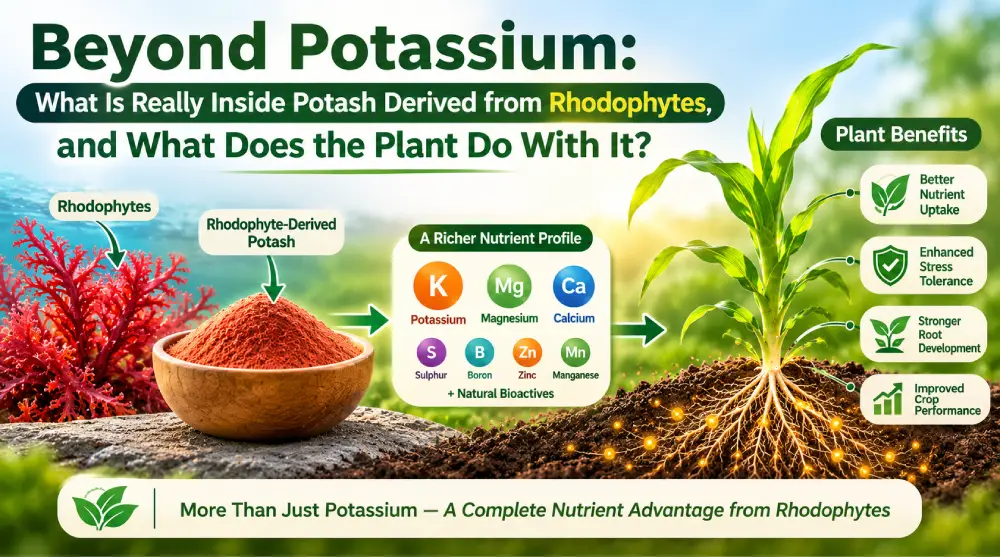
Biological-input research has increasingly investigated marine-algal materials for their effects on plant growth, nutrient-related processes, metabolism and stress responses. Reviews describe seaweed-derived materials as containing diverse compounds, including polysaccharides, proteins, phenolic compounds and other biologically active constituents. Research on red seaweed-derived carrageenans has also examined their potential roles in plant growth, photosynthesis and stress-related responses.
More recent research also highlights that the response to seaweed-based biostimulants can vary according to crop, formulation, extraction method, application strategy and environmental conditions.
For canopy-focused applications, the relevant question is not whether a formulation contains an impressive list of compounds.
The useful question is whether it can contribute to measurable aspects of vegetative performance.
Does the crop develop leaf area differently? Is biomass accumulation affected? Are chlorophyll-related indicators maintained or improved? Does canopy architecture change in a useful direction? Do physiological measurements support the visual response?
This evidence-first approach is more valuable than treating all marine-derived inputs as interchangeable.
Different biological sources, extraction processes and formulation strategies can produce materially different outcomes.
For agricultural applications, these questions also need to be considered alongside crop type, stress conditions and the intended physiological response. Trishul Biotech’s agriculture sector solutions provide context for this broader crop-focused approach.
Canopy Development and the Wider Crop System
Canopy performance does not exist independently of roots, soil, water and nutrient availability.
Leaf development depends on the plant’s ability to acquire resources and maintain physiological activity. Similarly, canopy function can influence the demand placed on the root system and the distribution of assimilates throughout the plant.
This is why canopy observations can become more informative when considered alongside other measurements.
For example, soil health and plant development can be viewed together rather than as isolated factors. Where appropriate, soil-health assessment can provide additional context when interpreting differences in crop growth and canopy development.
Trishul Biotech’s soil health technology is relevant to this broader physiological perspective.
The same principle applies to stress. Heat, drought, salinity and other environmental conditions can alter leaf expansion, stomatal behaviour, photosynthesis and biomass formation.
Understanding these interactions helps distinguish between a canopy that is simply large and one that remains functionally active under changing field conditions.
A Canopy Is the Crop’s Working Surface
The green surface seen from outside a field is the visible outcome of weeks of plant growth and development.
Inside that canopy, a much more complex process is underway. Leaves compete for light. Carbon is assimilated and redistributed. Water moves continuously through the plant. Nutrients support enzymes, pigments, membranes and structural development. New tissues expand while older tissues gradually change in function.
The canopy is therefore not simply “foliage.”
It is a working biological surface connecting environmental resources with crop growth.
That perspective changes how canopy development should be managed and measured.
Rather than pursuing maximum leaf growth, the objective becomes the development of an appropriately sized, physiologically active and well-arranged canopy capable of supporting the crop’s developmental requirements.
That is a much more useful definition of canopy performance.
Trishul Biotech applies this physiology-led approach to the development and manufacture of seaweed-derived agricultural biological inputs and plant biostimulant technologies spanning crop nutrition, nutrient-use efficiency, root development, abiotic-stress resilience and crop-quality management.
Rhodophyte-derived liquid technologies form part of this wider biological platform, with vegetative and canopy applications approached through measurable plant responses such as leaf development, biomass formation and photosynthetic performance rather than through visual greenness alone.
Also Read:-
- Plant Vigour Begins Before Yield: Why Vegetative Growth Builds the Crop’s Future
- Salinity Stress in Plants: How to Detect and Manage Crop Stress Before Visible Damage
More Useful Links:-
Agricultural Biotechnology Company | Organic Fertilizer For Plants | Biostimulant Products In Agriculture


2 thoughts on “The Crop Has a Solar Economy: Why Canopy Development Is More Than Growing More Leaves”
Comments are closed.