Crop performance is often judged by what we can see above the soil. Healthy leaves, a dense canopy, vigorous plant growth, flowering, and fruit development are all visible indicators of a successful crop.
However, these above-ground responses rarely develop on their own.
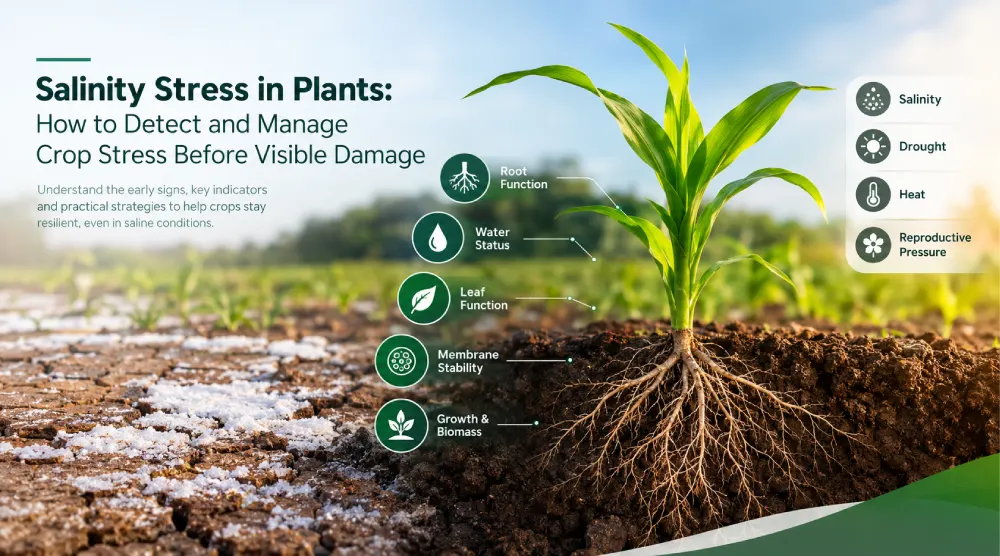
A crop’s visible growth begins with what happens below the surface. Healthy roots improve water uptake, nutrient absorption, and plant stability, creating the foundation for stronger canopy development. We call this relationship between underground growth and visible crop response the root-to-canopy signal.
Rather than viewing roots and canopy as separate systems, technical teams can build a clearer understanding of crop performance by evaluating both together.
Why the root-to-canopy signal matters
Looking only at the root system or only at the canopy provides an incomplete picture of crop performance.
Healthy roots support nutrient uptake and water availability, while the canopy reflects how effectively those resources are used for plant growth. Evaluating both together creates a more reliable measure of crop health.
This approach links root architecture and canopy development through observations that can be recorded and compared.
It is also important to recognise that canopy performance depends on multiple factors, including irrigation, nutrition, climate, soil health, crop genetics, and management practices. Root development is one important contributor within this larger production system.
When root measurements are combined with canopy observations, technical evaluations become more meaningful and easier to validate.
The below-ground foundation
Strong roots provide the foundation for consistent crop establishment and long-term performance.
Several measurable root performance indicators help evaluate below-ground development.
| Root Parameter | What it helps explain |
| Root length | Soil exploration and water access |
| Root volume | Active root-zone development |
| Root biomass | Below-ground growth and reserves |
| Feeder-root development | Nutrient and water absorption |
| Root-to-shoot balance | Allocation between roots and canopy |
| Tissue NPK | Nutrient movement within the plant |
Together, these indicators provide valuable insights into below-ground crop development before visible changes appear above the soil.
Understanding canopy performance indicators
While roots work below the surface, the canopy reflects the crop’s response through measurable growth signals.
Common canopy performance indicators include:
| Canopy Parameter | What it helps explain |
| Leaf area | Canopy development |
| SPAD | Chlorophyll status |
| NDVI | Canopy greenness and vegetation health |
| Plant height | Vegetative growth |
| Stem diameter | Structural strength |
| Canopy uniformity | Crop consistency across the field |
These measurements become most valuable when they are evaluated alongside root development and crop-stage observations rather than as standalone indicators.
Connecting root performance with canopy development
A well-developed root system enables crops to access water and nutrients more efficiently.
When strong root architecture supports early establishment, crops are better positioned to produce healthier canopy growth under suitable growing conditions.
Working from the root-to-canopy signal allows technical teams to evaluate how improvements in root development relate to canopy measurements such as leaf area, SPAD, NDVI, nutrient status, and field uniformity.
Instead of making broad claims about stronger growth, measurable data helps explain which root parameters improved, which canopy responses were observed, and how those outcomes were evaluated.
RaizUp: supporting measurable crop performance
RaizUp is the UpCrop pillar focused on root architecture, early establishment, rhizosphere activity, and nutrient capture, backed by Trishul Biotech’s Our Technology platform.
As part of Trishul Biotech’s biostimulant portfolio, RaizUp supports technical discussions around measurable root performance indicators and their relationship with canopy development.
Its framework encourages evaluation through multiple measurement layers, including root growth, tissue nutrient status, and canopy observations, helping technical teams communicate performance with greater confidence.
This balanced approach supports scientific credibility without over-claiming crop outcomes.
Why this matters for technical B2B buyers
Today’s B2B buyers expect biological products to be supported by measurable data.
Root measurements explain below-ground development, while canopy observations demonstrate how crops respond throughout the growing cycle.
By combining these indicators, biological companies can present stronger technical evidence, improve product positioning, and create more meaningful discussions with distributors, formulation partners, and commercial teams.
A performance-based framework also makes technical communication easier to understand across research, sales, and agronomy functions.
Conclusion
Healthy crop growth begins below the soil.
By connecting root architecture and canopy development, technical teams gain a clearer view of how underground processes influence visible crop growth.
Parameters such as root length, root biomass, root-to-shoot balance, tissue NPK, SPAD, NDVI, and leaf area provide a more complete picture of crop performance than visual observations alone.
At Trishul Biotech, the opportunity lies in evidencing the root-to-canopy signal through data-driven evaluation rather than broad biological claims.
The canopy reflects what the roots make possible.
Also Read:-