A dark-green crop creates confidence. It looks vigorous, well nourished and productive. But photosynthesis in plants depends on far more than visible colour. For generations, growers have used colour as one of the quickest visual indicators of crop condition, and with good reason: chlorophyll is essential to photosynthesis, while leaf yellowing can accompany nutrient deficiency, stress or senescence.
The difficulty begins when “greener” is automatically translated into “more photosynthesis,” and “more photosynthesis” is then translated directly into “more yield.”
Plant physiology is not quite that simple.
A leaf may contain substantial chlorophyll yet operate below its potential because stomata are restricted, temperature is unfavourable, water status is poor or metabolic limitations are affecting carbon fixation. A crop may show high chlorophyll-related readings while producing limited leaf area. Another crop may have extensive foliage but inefficient canopy architecture.
The colour of the crop matters, but it is only one layer of a much larger biological story.
To evaluate plant physiological performance properly, chlorophyll, photosynthesis, canopy development, biomass and plant metabolism need to be understood as related but distinct components.
How Does Chlorophyll Affect Photosynthesis in Plants?
Chlorophyll Starts the Conversation
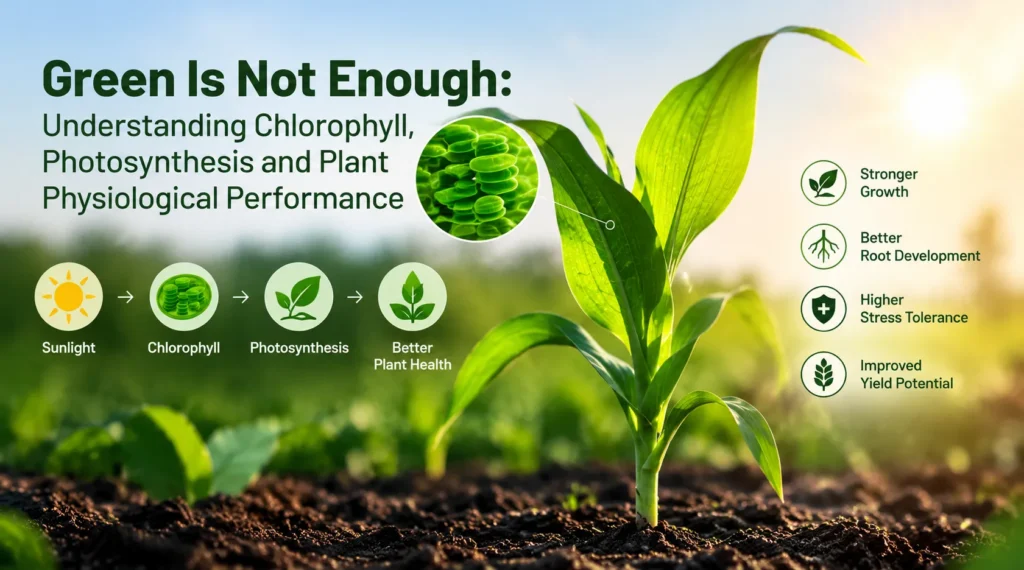
Chlorophyll pigments allow plants to absorb portions of visible light and transfer that captured energy into the photochemical reactions that support photosynthesis in plants.
Without functional chlorophyll-containing tissues, normal photosynthetic activity cannot be maintained.
That makes chlorophyll content an important indicator in crop physiology.
Changes in leaf chlorophyll can be associated with plant development, nitrogen status, nutrient limitations, stress responses and senescence. Measuring chlorophyll-related characteristics can therefore provide useful information before some changes become visually obvious.
However, knowing how much chlorophyll is present is not the same as knowing exactly how efficiently the leaf is assimilating carbon.
That distinction is important when interpreting crop trials and biological-input studies.
SPAD Meter Chlorophyll Readings: Useful but Specific
SPAD meter chlorophyll readings are widely used because they provide rapid, non-destructive measurements related to leaf chlorophyll status.
Instead of removing leaves, extracting pigments and analysing them chemically, researchers and agronomists can take repeated measurements on living plants.
This makes a SPAD meter chlorophyll reading extremely practical.
But a SPAD value is an optical measurement, not a direct laboratory measurement of absolute chlorophyll content in plants, and it is not a direct measurement of photosynthetic rate.
Studies comparing SPAD readings with measured chlorophyll have shown useful relationships in many circumstances, while also demonstrating that the relationship can be non-linear and can vary among species because leaf optical characteristics and chlorophyll distribution influence the measurement.
SPAD is therefore best used for what it does well: detecting relative differences and trends in chlorophyll-related leaf status when measurements are taken consistently.
If a treatment produces a higher SPAD reading, that is useful evidence.
It should not automatically be rewritten as “photosynthesis increased by the same amount.”
What Does Chlorophyll Fluorescence Tell Us About Plant Function?
When light reaches chlorophyll, some energy drives photochemistry, some dissipates as heat and a small portion is re-emitted as fluorescence.
Measuring chlorophyll fluorescence allows researchers to investigate aspects of the photosynthetic apparatus, particularly photosystem II.
Parameters such as the maximum quantum efficiency of PSII are frequently used in plant-stress and physiological studies because changes in fluorescence can reveal disturbances that may not yet be obvious from visual appearance.
Fluorescence therefore answers a different question from SPAD.
SPAD relates primarily to optical properties associated with chlorophyll.
Fluorescence provides information about aspects of photochemical function.
Gas-exchange systems directly examine processes such as carbon assimilation and stomatal conductance.
Remote-sensing indices observe canopy reflectance.
Biomass measures accumulated growth.
Photosynthesis Involves Far More Than Chlorophyll
Photosynthesis is an integrated process.
Light energy has to be absorbed. Photochemical reactions generate energy carriers. Carbon dioxide must enter the leaf through stomata. The photosynthetic machinery must fix that carbon into organic compounds. Enzymes need to remain functional. Water relations need to support cellular activity and gas exchange.
Temperature influences several of these processes.
Nutrient status influences enzymes, pigments and metabolic machinery.
Stress can alter membranes, stomatal behaviour, electron transport and antioxidant activity.
Consequently, photosynthetic efficiency cannot be understood from pigment concentration alone.
A leaf may contain adequate chlorophyll while stomatal closure restricts carbon dioxide availability. Under another condition, photochemical processes may be impaired even though visible greenness has changed very little. In yet another crop, photosynthesis per unit leaf area may remain adequate but total canopy leaf area may be insufficient to support strong whole-plant carbon gain.
This is why photosynthesis needs to be considered at more than one scale.
Photosynthetic Efficiency and Photosynthetic Capacity Are Not Identical
The phrases photosynthetic efficiency and photosynthetic capacity are sometimes used interchangeably in general agricultural communication, but they can describe different aspects of crop physiology.
Photosynthetic efficiency broadly concerns how effectively the photosynthetic system converts available energy and resources under given conditions. Depending on the measurement approach, researchers may examine photochemical efficiency, carbon assimilation or other physiological responses.
Photosynthetic capacity is more often used to describe the potential rate or functional capacity of the photosynthetic machinery under defined conditions.
At crop scale, however, another layer appears.
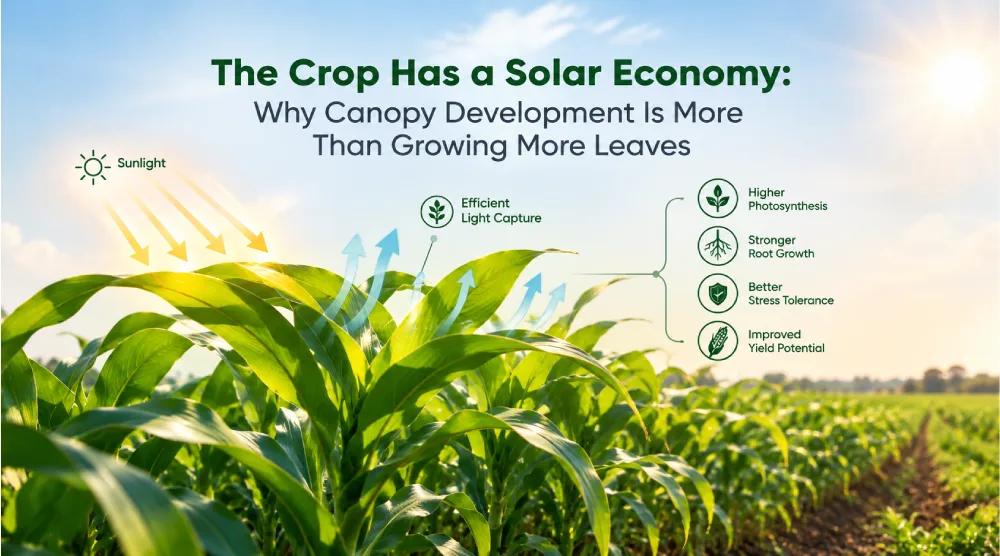
A field does not perform photosynthesis as one giant leaf. Whole-crop carbon gain depends on how many leaves exist, where they are positioned, how much light each layer receives, how long leaves remain active and how their individual rates combine across the canopy.
This means photosynthetic performance in agriculture is an interaction between leaf physiology and canopy development.
A crop can improve one without necessarily maximizing the other.
NDVI in Agriculture: Moving from the Leaf to the Field
Normalized Difference Vegetation Index, or NDVI, is one of the most widely used tools for NDVI in agriculture, assessing vegetation condition from reflected red and near-infrared light.
At field, drone or satellite scale, it provides an efficient way to observe spatial and temporal differences in vegetation.
NDVI can provide useful information about vegetation greenness, relative density and condition. However, it also has limitations, particularly when vegetation becomes very dense.
This becomes particularly relevant when evaluating vigorous crops.
As the canopy becomes dense, additional increases in leaf area or biomass may not create proportional increases in NDVI. A field can therefore be biologically changing while the vegetation index becomes less sensitive to those changes.
NDVI is highly useful, but it should be interpreted as one component of canopy assessment, not as a direct replacement for measurements of chlorophyll, photosynthetic rate, LAI or biomass.
Biomass Is the Accumulated Result
If chlorophyll tells us something about pigment status, fluorescence about photochemical function and gas exchange about carbon assimilation at the measurement moment, biomass accumulation tells us what the plant has constructed over time.
Biomass integrates many processes.
The crop had to intercept radiation, assimilate carbon, obtain water and mineral nutrients, synthesize organic compounds and allocate those resources to tissues.
This makes biomass particularly valuable in studies of vegetative growth and crop vigor.
A short-lived change in one physiological indicator becomes more convincing when it is accompanied by meaningful changes in plant development.
For example, an increase in chlorophyll-related status is biologically interesting. If it occurs alongside greater leaf area and greater shoot biomass, the response begins to describe a broader growth pattern.
Likewise, increased biomass accompanied by stronger canopy development and physiological measurements provides a richer picture than biomass alone.
Plant performance becomes most persuasive when evidence converges.
Plant Metabolism Connects the Measurements
Much of agriculture is observed from the outside. We measure height, leaf area, colour, biomass, fruit number or yield.
The processes creating these outcomes occur largely inside the plant.
Plant metabolism includes an enormous network of reactions responsible for energy transfer, carbon metabolism, nitrogen assimilation, amino-acid formation, protein synthesis, carbohydrate production, antioxidant processes and the generation of structural and signalling molecules.
Photosynthesis supplies carbon skeletons and chemical energy. Nutrients contribute to enzymes, electron carriers, proteins, pigments and cellular structures. Respiration releases energy needed to sustain cellular processes. Sugars act both as energy sources and signalling molecules.
Growth therefore depends on coordination.
A plant may acquire a nutrient but still need to assimilate it correctly. It may produce carbohydrates but still need to distribute them between growing tissues. It may maintain chlorophyll but experience another metabolic limitation.
Plants are systems.
Why Multiple Measurements Matter for Biological-Input Research
Consider a hypothetical biological treatment evaluated during vegetative development.
At the first observation, treated plants show higher SPAD values. That suggests a difference in chlorophyll-related status.
At the next observation, leaf area is also greater.
Later, treated plants have accumulated more shoot dry biomass.
A canopy measurement shows a difference in vegetation development.
If the study also includes direct physiological measurements showing altered photosynthetic behaviour, the interpretation becomes increasingly robust.
No single parameter is carrying the entire claim.
Instead, several observations describe a coherent biological response.
Now imagine another treatment produces only taller plants.
Without data on leaf area, biomass, stem development or physiology, it becomes much more difficult to determine whether the response represents useful crop vigor or simply elongation.
This is why scientifically credible crop growth biostimulant development should begin with the intended physiological function and then choose measurements capable of testing that function.
The measurement should follow the claim, not the other way around.
Can Better Photosynthetic Performance Improve Crop Productivity?
The temptation is understandable.
Chlorophyll is associated with photosynthesis. Photosynthesis produces carbohydrates. Carbohydrates contribute to growth. Growth contributes to productive capacity.
But several biological steps sit between these processes and harvestable yield.
Reproductive development may be affected by temperature or water stress. Flowers may fail to set. Nutrient availability can change. Disease or pests can reduce functional leaf area. Sink strength can limit how much assimilated carbon becomes economic yield.
So an increase in chlorophyll content cannot be responsibly converted into a guaranteed increase in crop productivity.
The stronger statement is that maintaining functional chlorophyll status, photosynthetic activity and canopy capacity contributes to the physiological system on which biomass production and later reproductive development depend.
This is still agronomically significant.
It is simply more accurate.
Photosynthetic Performance Is Dynamic
Leaves do not operate at one fixed photosynthetic rate throughout the crop cycle.
Morning and afternoon conditions differ. Irradiance changes. Leaf temperature changes. Stomata respond to vapour-pressure deficit and water availability. Nutrients move within the plant. Leaves mature and eventually senesce.
A photosynthesis measurement therefore represents the plant at a particular time and under particular conditions.
This is why repeated measurements and developmental context improve interpretation.
A treatment that helps the crop maintain physiological activity through an important vegetative window may be more valuable than a short-lived peak measured at one date.
The same principle applies to SPAD, NDVI and biomass.
Trends matter.
The goal is not necessarily to produce the highest possible reading for every parameter. It is to create a crop that develops and maintains the physiological capacity appropriate for its stage and production objective.
From Photosynthetic Efficiency to Crop Productivity
Agriculture ultimately cares about performance at field scale.
For photosynthetic physiology to contribute to crop productivity, captured carbon must eventually be allocated into economically useful sinks.
The plant needs sufficient source capacity, but it also needs sink demand, transport capacity, nutrient balance and appropriate environmental conditions.
This source-sink relationship is one reason vegetative development matters before reproductive development begins.
A functional canopy with adequate leaf area and photosynthetic capacity can provide a stronger source system. When reproductive sinks become active, the plant then has greater biological infrastructure from which to support them.
Again, this does not allow simple one-to-one predictions of yield potential.
It explains why physiology matters.
Crop productivity is the final outcome of many successful processes operating sequentially and simultaneously.
Photosynthesis is one of the most fundamental of those processes, but it works as part of a system.
Biological Support Should Target Function, Not Colour
The agricultural biological-input sector increasingly includes technologies intended to support physiological processes rather than simply supply large quantities of conventional nutrients.
For vegetative-stage crop management, this creates opportunities to investigate biological formulations in relation to leaf development, chlorophyll status, photosynthetic behaviour, biomass accumulation and canopy function.
A credible biological solution should not be described simply as a material that “makes crops greener.”
The more useful question is whether it supports measurable plant physiological performance.
That requires evidence.
For broader information on biological-input technologies, Trishul Biotech’s plant biostimulant solutions provide context around its crop-focused biological platform.
Green Is the Beginning of the Question
A green crop tells us that chlorophyll-containing tissues are present.
From there, the interesting questions begin.
How much functional leaf area does the crop have? What is the chlorophyll status of those leaves? How efficiently is the photosynthetic apparatus functioning? How is the canopy intercepting light? Is the plant converting those resources into useful biomass? Is physiological performance being maintained over time?
It also creates a better framework for biological-input development because the objective shifts from creating an attractive visual response to supporting functional plant processes.
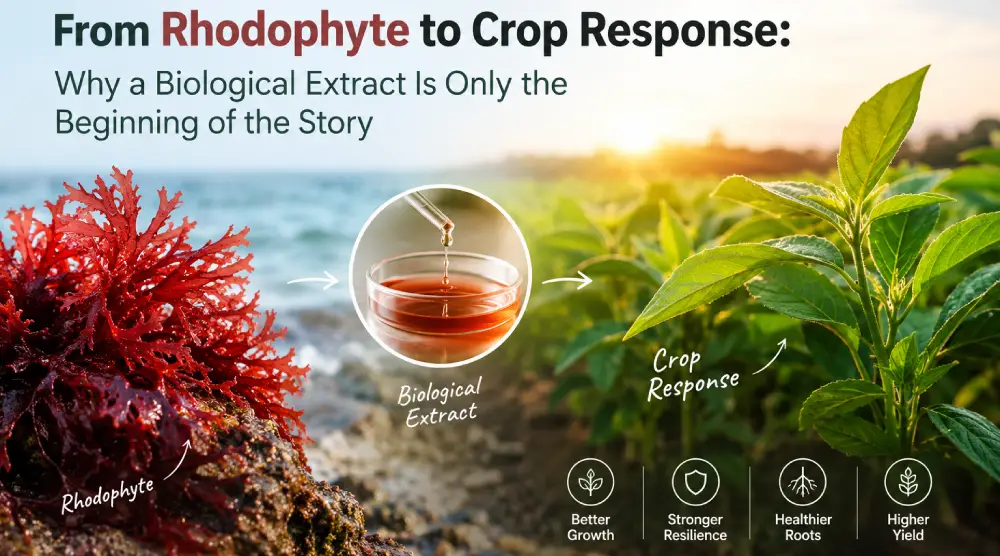
Trishul Biotech develops and manufactures seaweed-derived agricultural biological inputs and plant biostimulant technologies designed around distinct areas of crop physiology, including crop nutrition, nutrient-use efficiency, root development, abiotic-stress resilience and crop-quality management. For vegetative and canopy applications, Rhodophyte-derived liquid biological technologies are being developed within this broader framework, with emphasis on measurable plant growth, chlorophyll-related performance, photosynthetic capacity and biomass rather than colour alone.
Also Read:-
- The Crop Has a Solar Economy: Why Canopy Development Is More Than Growing More Leaves
- Plant Vigour Begins Before Yield: Why Vegetative Growth Builds the Crop’s Future
More Useful Links:-
Agricultural Biotechnology Company | Organic Fertilizer For Plants | Biostimulant Products In Agriculture