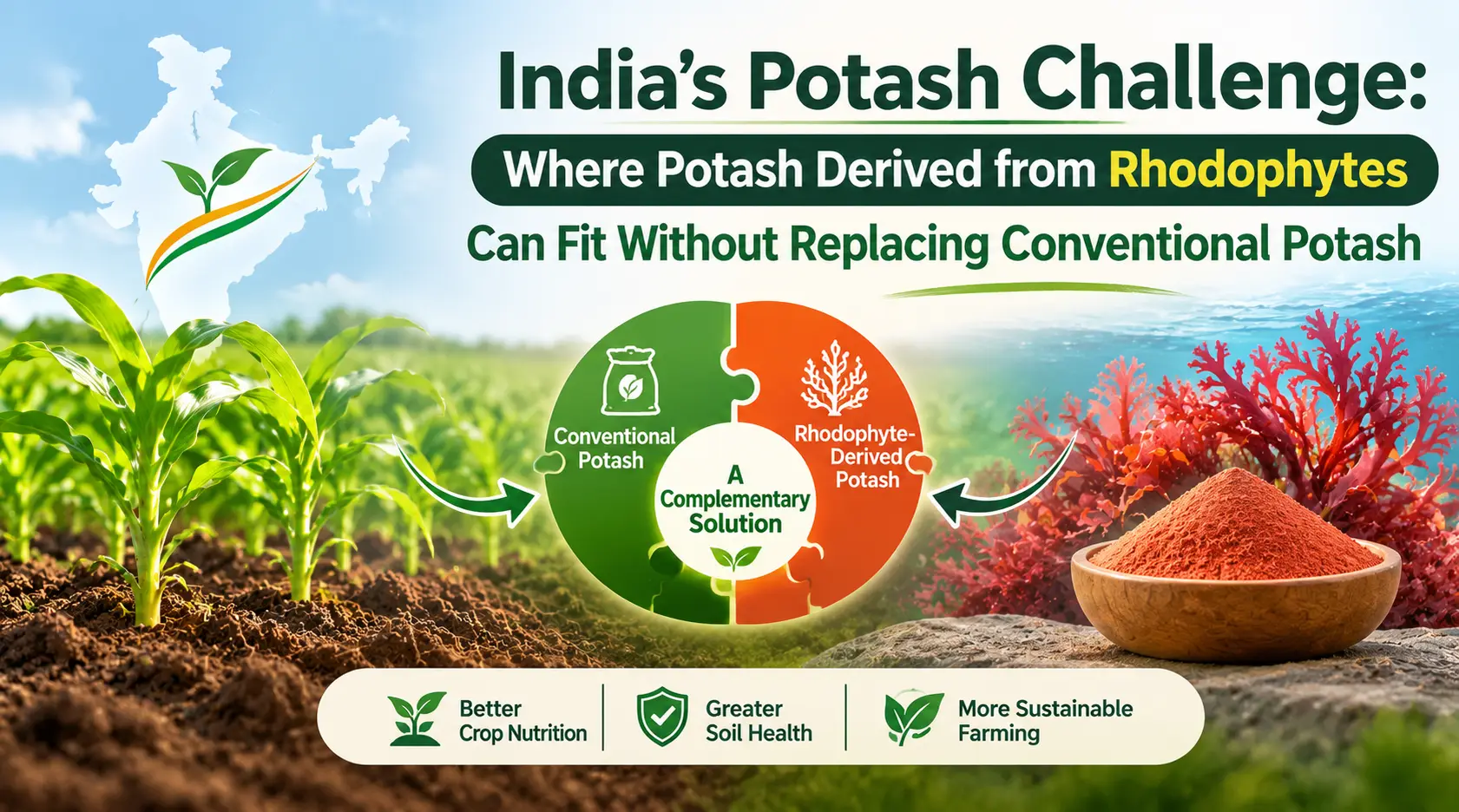
Potassium is essential to Indian agriculture, but India has a structural problem with where its conventional potash comes from.
Unlike nitrogen, where India has large domestic urea manufacturing capacity, the country has virtually no commercially viable potash reserves for producing Muriate of Potash (MOP) at scale. “ICRIER puts India’s import dependence for MOP at almost 100%. So every conversation about conventional potash in India is also, whether we say it out loud or not, a conversation about trade, shipping routes, supplier concentration, currency and geopolitics.
That does not make conventional potash a bad choice. MOP is still an important, highly concentrated and globally proven potassium fertilizer. It delivers a lot of K efficiently and economically where fields need bulk potassium correction.
The problem is dependence.
That is why India needs a more nuanced conversation about complementary potassium sources, including Potash Derived from Rhodophytes (PDR).
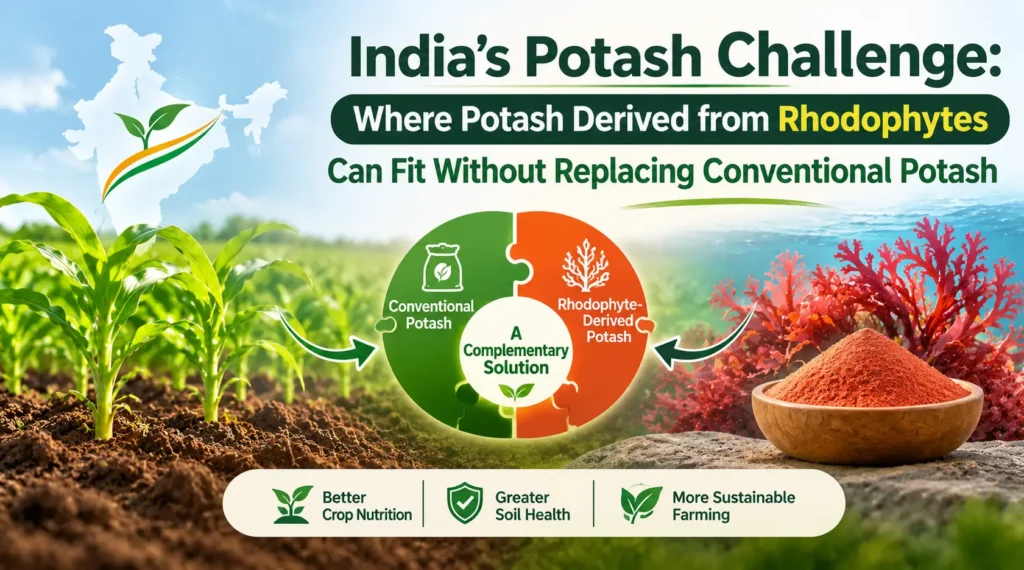
PDR should not be pitched as a replacement for MOP. Conventional potash stays central to Indian crop nutrition. The more realistic opportunity is to position domestically made Rhodophyte-derived potash as a supporting organic potash fertilizer that widens India’s potassium options and brings a different biological and regulatory profile to the market.
How dependent is India on potash imports?
India’s potash imports would be less of a worry if supply came from many independent sources. In practice, it is concentrated.
An ICRIER assessment of India’s fertilizer security reported that India imported around 3.54 million tonnes of MOP in 2024-25. About 51% came from Russia, 25% from Canada, 8% from Jordan and 8% from Israel. In other words, more than 90% of supply came from just four countries.
That concentration creates several kinds of risk.
A disruption does not have to happen in India to hit Indian farms. Conflict in an exporting country can change trade flows. Sanctions can complicate finance and logistics. Shipping problems can stretch transit times. Port congestion can affect availability. Currency swings can change the landed cost even if the commodity price stays flat.
We have already seen how fast these pressures move. ICRIER notes that reliance on Russia is particularly sensitive because the Russia-Ukraine war has already disrupted global fertiliser markets through sanctions, trade restrictions and logistical bottlenecks.
So this is not a theoretical risk.
For India, potassium fertilizer is directly tied to global geopolitics.
Why do shipping routes matter for potassium fertilizer in India?
Fertilizer supply chains are physical systems.
Product has to leave a mine or plant, move through ports, cross sea routes and reach India in time for the season that needs it.
ICRIER’s 2026 policy brief flags the Strait of Hormuz as a critical shipping corridor for fertiliser supply chains and warns that prolonged instability can tighten supply and raise input costs. It also flags the risks that come with supplier concentration and regional conflict.
Potash reaches India from several directions, but the wider message is clear: nutrient security is increasingly linked to trade-route security.
That does not mean India should try to stop importing potash. With current domestic mineral resources, that is not realistic.
It means diversification has real strategic value.
That can happen across supplier countries, contracts and shipping routes. It can also include building complementary domestic nutrient technologies where they make agronomic sense.
This is where PDR gets interesting.
What exactly is Potash Derived from Rhodophytes?
PDR is not a marketing phrase built around seaweed. It is a recognised fertilizer category in India.
The Government of India’s National Centre for Organic & Natural Farming lists Potash Derived from Rhodophytes among the organic fertilizers under Schedule IV of the Fertiliser (Control) Order. The published specification requires a minimum of 20% water-soluble potash and a minimum of 1.5% total sulfur, along with limits for specified heavy metals.
That regulatory recognition matters.
It means PDR already has a defined place in India’s fertilizer framework as an organic fertilizer, rather than being a loose biological concept. India’s other domestic potash route is potash derived from molasses (PDM), a sugar-industry by-product. PDM has a minimum of 14.5% potash and has been covered by the Nutrient Based Subsidy since 2021. Both give India a domestic route to potassium, but they come from completely different raw materials and processes.
Trishul Biotech’s PDR is developed within this FCO-recognised category and manufactured in India from Rhodophyte (red algae) biological resources. Its soluble PDR grade can contain water-soluble K₂O up to approximately 33% while meeting the applicable FCO compliance framework. It is also positioned as an organic-certified, non-toxic agricultural input made through Trishul Biotech’s own domestic production system.
That gives it a very different profile from conventional MOP. Different does not automatically mean better. It means the two are suited to different jobs.
Is PDR an alternative to Muriate of Potash?
Not as a like-for-like swap.
MOP is highly concentrated potassium chloride, normally used when a field needs a lot of potassium. Its nutrient density, proven fertilizer value and global supply chain make it very hard for any specialised organic source to replace kilogram for kilogram.
That is the wrong comparison for PDR anyway.
A PDR product with up to 33% K₂O carries less potassium than conventional MOP. If the only goal is to deliver the most K at the lowest nutrient cost for a big basal correction, conventional potash clearly has its role.
PDR belongs in a different part of the potassium programme.
It works as a supporting organic potassium source within integrated nutrient management, specialty crop programmes, biological input programmes and systems that want a domestically made, Rhodophyte-derived input. It also fits naturally as potash for organic farming, where standards such as India’s NPOP generally do not permit potassium chloride and growers need a certified potassium source.
That complementary position is stronger, both scientifically and commercially, than claiming one should wipe out the other.
The question is not “MOP or PDR?”
It is:
Where does each source create the most agronomic value?
How do conventional potash and PDR solve different problems?
Conventional MOP brings scale. It is standardised, concentrated and very effective for bulk potassium nutrition.
PDR brings a different mix: water-soluble potassium, sulfur within the FCO-defined category, organic fertilizer status, a marine biological matrix and Indian manufacturing. This is also what sets it apart from generic seaweed potash claims, because PDR has a defined regulatory specification behind it.
That difference matters for NutriSpike.
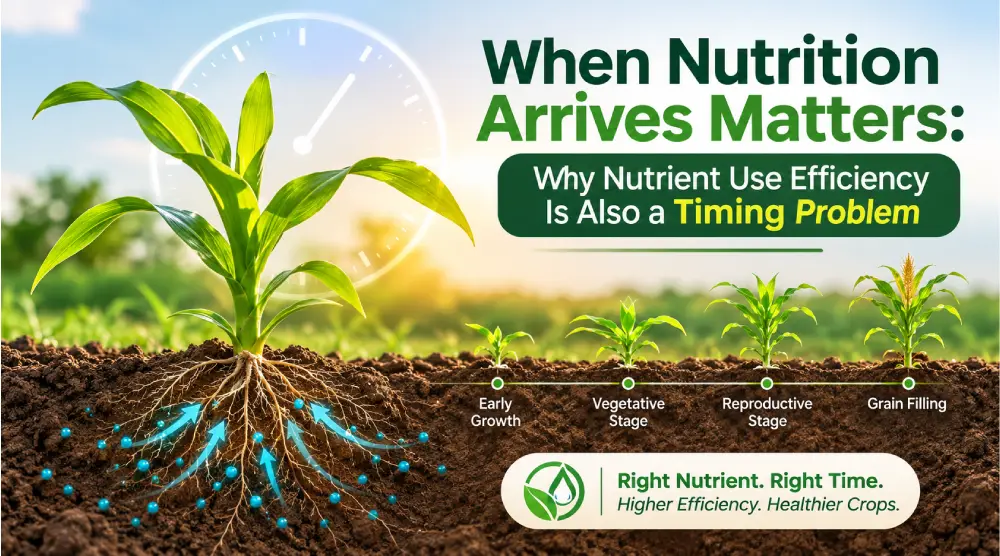
NutriSpike is not built on the idea that crop nutrition is a contest between nutrient percentages. It is built around nutrient performance: availability, uptake, utilisation and physiological function. We explain that idea in The Nutrients Are There. Can the Crop Actually Use Them?
So PDR’s nutritional contribution starts with potassium. Its potassium should be measured and treated as potassium. The biological component should then be assessed separately, through composition analysis and plant response data. That avoids the common mistake of calling every marine-derived nutrient source a biostimulant just because it came from algae.
Why does domestic manufacturing matter?
India cannot make conventional mineral potash at meaningful scale without mineable reserves.
PDR creates a different kind of domestic opportunity, because its raw material comes through a biological manufacturing route rather than a geological mining one.
Trishul Biotech runs its own manufacturing facility in Tamil Nadu and publicly describes a 60,000-square-foot plant capable of processing marine algae and scaling agricultural formulations. That makes Trishul Biotech a potash derived from rhodophytes manufacturer in India, with in-house processing from raw material to finished product.
Domestic production does not remove all supply chain risk. Biological raw materials still need reliable sourcing, energy, logistics, quality control and processing. But it changes the nature of that risk.
A domestically made PDR input does not depend on importing mined MOP from Russia, Canada or anywhere else before each kilogram can reach Indian farms.
That gives PDR a strategic role beyond its nutrient analysis. At a specialised scale, it helps diversify India’s potassium input mix.
Is PDR more sustainable than mined potash?
It would be easy to turn this into a broad green claim: marine resources are renewable, so PDR must be better for the environment than mined potash.
That is too simple. Sustainability depends on how the biomass is sourced and processed, energy use, transport, manufacturing efficiency, application rate and how well it actually works in the field.
The stronger case for PDR is more concrete.
It is a domestically made organic fertilizer category already recognised under India’s FCO. It provides water-soluble potassium from a Rhodophyte source. It supports diversified potassium programmes. And because it comes through a biological manufacturing route, it adds an option alongside India’s fully imported MOP supply.
That is already a meaningful position. There is no need to overstate it.
Why does the biological matrix still matter?
If PDR were just potassium pulled out of red algae with nothing biologically relevant left, its story would mostly end at the nutrient analysis.
Trishul Biotech’s research and development programme has taken the question further.
The company has carried out detailed chemical composition analysis of its PDR, followed by bioactive profiling and transcriptomic analysis, to see whether the Rhodophyte-derived matrix carries biological information relevant to plant function.
Trishul Biotech has publicly reported finding amino acids and several classes of marine-associated bioactive compounds in its PDR, and has used gene expression analysis in tomato to study plant responses beyond basic potassium nutrition.
That research does not change the first principle: PDR is a potassium-containing organic fertilizer.
But it opens a second scientific question.
Is the biological matrix doing something alongside the potassium?
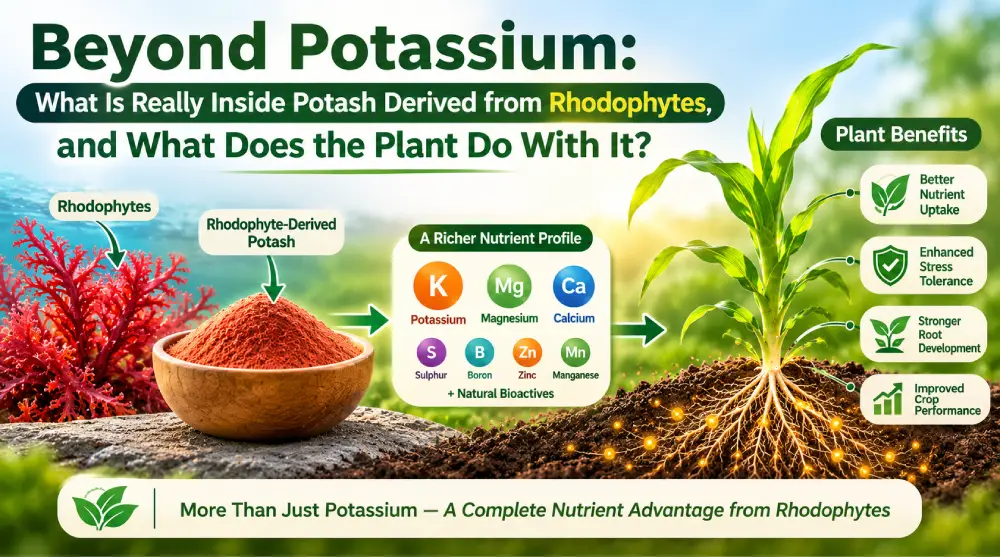
That question belongs to evidence, not assumption. We dig into it in Beyond Potassium: What Is Really Inside Potash Derived from Rhodophytes?
A supporting product, not a substitute
This is the positioning that makes the most sense for India.
Conventional potash stays essential for supplying bulk K where soil tests and crop demand justify it.
PDR can sit alongside it as a specialised organic, water-soluble, Indian-made potassium input with a distinct Rhodophyte-derived composition.
For growers, formulators and fertilizer companies, that adds flexibility. PDR can be built into nutrient programmes rather than pitched as an ideological alternative to conventional fertilizers.
For Indian agriculture, it offers something strategically useful: another potassium pathway in a country where the conventional one is entirely import-dependent.
Trishul Biotech’s PDR is manufactured in India, formulated within the FCO Schedule IV PDR category, available in soluble grades with K₂O up to approximately 33%, and backed by analytical, biological and crop response research.
The goal is not to replace conventional potash.
It is to make India’s potassium toolbox broader, more biologically informed and less dependent on one type of source.
India will keep needing imported MOP.
That should not stop Indian agriculture from building its own complementary potassium technologies.


One thought on “India’s Potash Challenge: Where Potash Derived from Rhodophytes Can Fit Without Replacing Conventional Potash”
Comments are closed.