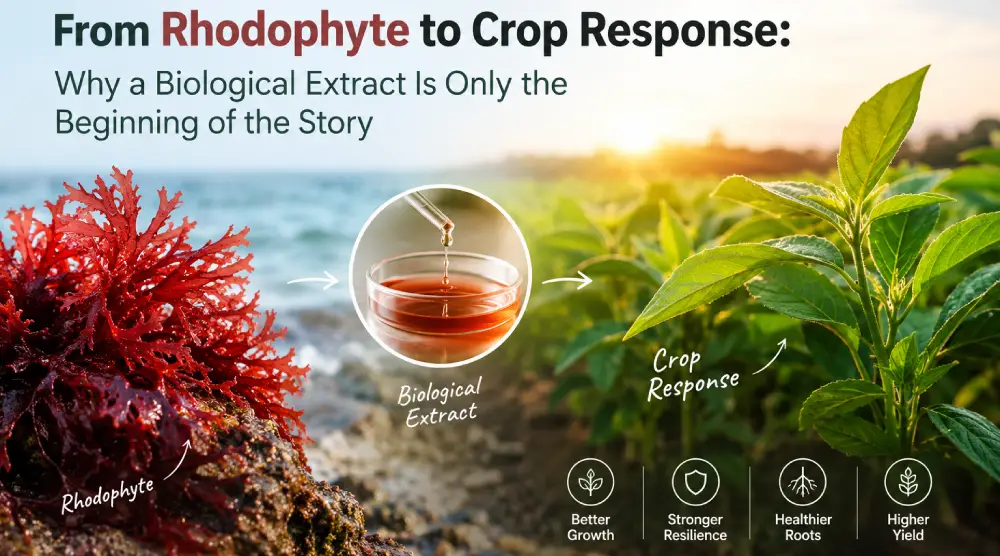
Agricultural biologicals are often introduced through their ingredient. A microbial strain. An amino-acid source. A humic fraction. An algal species. The ingredient matters, but it is rarely the entire technology. This is especially true for Rhodophyte-derived plant biostimulants.
Two agricultural products can originate from red marine algae and still differ considerably in chemical characteristics and crop response. The species can be different. The raw material can be harvested under different biological conditions. Extraction temperature, water ratio, pH, filtration, concentration and downstream processing can differ.
One process may retain certain soluble fractions more effectively than another. Final concentration and formulation can alter how much biological material reaches the plant. So when someone asks, “What does a Rhodophyte extract do to crops?”, the scientifically useful answer begins with another question:
Which Rhodophyte extract?
That distinction is important because the future of agricultural biological inputs will increasingly depend on moving beyond broad ingredient categories towards better characterization of biological source, extraction, formulation, dose, crop response and field function.
What Makes a Rhodophyte-Derived Plant Biostimulant Different?
A Rhodophyte-derived plant biostimulant is made from red algae, but its performance depends on more than its origin. The algal species, extraction process, formulation and dose all shape its biological characteristics and how crops respond. Two products from red algae can therefore behave very differently in the field.
Rhodophyta Is a Biological Category, Not a Standardized Ingredient
Rhodophyta includes a diverse group of red algae with different biochemical characteristics. A red algae biostimulant can therefore differ widely from one product to the next.
They can contain polysaccharides, proteins, amino acids, minerals, pigments, phenolic compounds and other metabolites in proportions that vary with species, environment, developmental stage and processing.
Once agricultural extraction begins, another layer of variation is introduced.
Extraction conditions determine which components become soluble, how large biological polymers are transformed or retained, whether heat-sensitive components are preserved and what eventually appears in the concentrated extract.
Consequently, the phrase Rhodophyte-derived describes biological origin, but it does not fully describe the resulting agricultural technology.
Knowing that two products originated from the same broad source does not prove that their biochemical composition or agronomic performance is identical.
The extraction process is part of the product.
How Does Biostimulant Extraction Technology Affect Crop Response?
Imagine two processors beginning with the same Rhodophyte biomass.
One uses relatively mild aqueous extraction.
Another changes temperature, extraction duration and concentration conditions.
The resulting liquids are unlikely to be completely identical.
Polysaccharide solubility can change. Molecular-size distribution can change. Some fractions may be concentrated. Others may degrade, precipitate or remain in the insoluble material.
A recent review of algae-derived biostimulants compares extraction techniques by how efficiently they recover bioactive compounds, which is why biostimulant extraction technology can shape the final product. A recent meta-analysis of seaweed extract biostimulants also found that crop yield responses depend on application strategy, formulation and extraction method
When evaluating a crop growth biostimulant, agricultural performance should not be predicted only from the name of the raw material.
The same principle applies to a seaweed extract for agriculture. Knowing that a product originates from marine algae provides useful information about its source, but the final biological characteristics depend on how that material is processed and formulated.
That makes manufacturing science part of crop science.
Does Analytical Composition Prove an Extract Works?
Analytical characterization can identify compounds or compound classes present in a biological extract.
This is essential information if an extract contains particular polysaccharide fractions, amino acids, mineral components or other metabolites, researchers can begin developing hypotheses about potential biological functions.
But analytical composition is the beginning of the evidence chain. It is not the end. Finding a biologically interesting compound does not prove that the final formulation will improve vegetative growth. Detecting an osmolyte does not automatically prove abiotic-stress tolerance. Identifying a polysaccharide does not establish crop productivity.
The material still has to interact with a living plant. That interaction depends on dose, route of application, crop species, developmental stage, formulation, environmental conditions and numerous aspects of plant metabolism.
A strong biological technology therefore connects what is present with what the plant actually does.
How Do Plants Perceive and Respond to Biological Stimulation?
Plants constantly perceive and respond to their physical, chemical and biological environment.
Leaves and roots contain receptors and transport systems. Cells exchange signals. Hormonal networks coordinate development. Sugars function not only as carbon sources but also as signalling molecules. Reactive oxygen species can serve both as damaging agents and regulated signals. Nutrient availability influences metabolism and gene activity.
When a biologically complex formulation reaches plant tissue, the response does not have to resemble conventional nutrient feeding.
Instead, particular components may interact with existing physiological pathways, influence signalling or alter metabolic activity.
This is one reason the concept of a plant biostimulant is distinct from simply calling something a fertilizer.
Under the EU Fertilising Products Regulation, a plant biostimulant is defined as a product that stimulates plant nutrition processes independently of the product’s nutrient content, with the sole aim of improving nutrient-use efficiency, tolerance to abiotic stress, quality traits or the availability of confined nutrients in the soil or rhizosphere.
The significance of that definition is conceptual as well as regulatory. The important question becomes less about how many nutrients are present and more about what biological function can be demonstrated in the plant.
The important question becomes less about how many nutrients are present and more about what biological function can be demonstrated in the plant.
From Plant Perception to Visible Growth
Many of the earliest responses to biological stimulation cannot be seen with the naked eye. Changes may first occur at biochemical, molecular or cellular level.
Enzyme activity may change. Metabolic pathways may shift. Nutrient assimilation can be influenced. Signalling networks may respond. Cellular division or expansion can be altered.
Only later do some of these responses become visible as differences in plant growth and development.
- A leaf expands.
- A stem becomes thicker.
- More branch or tiller development occurs.
- Chlorophyll-related measurements change.
- The canopy occupies more space.
- Shoot biomass increases.
These visible outcomes are downstream expressions of many underlying processes.
This helps explain why the biological-input industry benefits from connecting analytical chemistry, plant physiology and agronomy rather than relying on any one discipline alone.
A formulation is created in manufacturing, but its real meaning is revealed by the plant.
Why Vegetative Growth Is an Important Biological Target
The vegetative stage offers a particularly useful window for evaluating plant-growth technologies because multiple physiological processes are highly active.
Leaves are expanding. Roots are developing. New cells are being produced. Biomass is accumulating. The plant is building its photosynthetic surface. Nutrients are being assimilated into structural and metabolic components.
Supporting this stage can therefore be relevant to plant vigor, canopy formation and subsequent productive capacity.
But once again, the objective should not simply be “more growth.”
A useful Rhodophyte-derived biostimulant should support an agronomically appropriate pattern of development.
The strongest interpretation does not come from whichever parameter produces the largest percentage difference.
It comes from whether the collection of measurements describes a biologically coherent response.
What Is the Mode of Action of a Plant Biostimulant?
One reason plant biostimulants are scientifically interesting is that their effect does not always fit neatly into one pathway.
A complex biological extract can contain multiple fractions capable of interacting with different components of plant metabolism.
Plants themselves operate through interconnected networks.
Attempting to describe such a system with a single universal biostimulant mode of action can therefore be misleading.
A useful mode-of-action framework should connect the biological material with measurable physiological responses rather than assuming that every formulation works through exactly the same pathway.
This uncertainty is not a reason to avoid scientific investigation. It is a reason to build better evidence.
Why Does Dose Matter in Biological Inputs?
There is another assumption that biological-input development needs to challenge: if a small amount produces a response, more should produce a larger response.
Biological systems frequently do not behave linearly.
A low dose may produce little measurable effect. An intermediate dose may produce a useful physiological response. A higher dose may produce no additional benefit or could even shift the response unfavourably.
This is why dose optimization matters.
The appropriate rate has to consider biological efficacy, crop sensitivity, application method, formulation concentration, field practicality and farmer economics.
A technically impressive formulation that requires an economically unrealistic dosage is not a complete agricultural solution.
Likewise, the cheapest dose is not automatically the best if physiological performance falls below the level needed to produce a consistent commercial response.
Good product development sits at the intersection of biology and practical agriculture.
Why Do Rhodophyte-Derived Biostimulants Differ in Crop Response?
No agricultural biological should be considered universally effective merely because it performs well in one crop.
Species differ in leaf structure, root architecture, metabolism, developmental timing and sensitivity to environmental conditions.
Even cultivars within the same crop can respond differently.
Application timing can also change performance. A formulation used during early establishment is interacting with a different physiological system from the same formulation applied during flowering or fruit development.
This is why the phrase crop growth biostimulant needs qualification.
- What growth?
- At what stage?
- Measured how?
- Under what conditions?
- For which crop?
The more precisely these questions are answered, the more commercially meaningful the resulting positioning becomes.
How Do Environmental Conditions Change Product Performance?
Agricultural products do not operate in controlled laboratory isolation.
A formulation that produces a strong response under optimal conditions may behave differently during heat or water deficit. Another biological input may reveal its greatest value when the plant is experiencing environmental limitation.
For this reason, controlled experiments and field trials answer different questions.
Controlled experiments help investigate causality and physiological response under reduced variability.
Field trials establish whether the technology remains useful under real agricultural complexity.
Neither should automatically replace the other.
The strongest product development programs build progressively from analytical characterization to controlled biological evaluation and then to replicated field validation.
From Raw Material to Field Result: The Evidence Chain
A useful way to think about biological-input development is as a continuous chain.
The biological source determines the starting material.
Extraction determines what is recovered.
Analytical characterization tells us what the processed material contains.
Plant-level experiments reveal potential physiological responses.
Formulation development determines how that material can be delivered practically.
Controlled and field trials test whether those responses translate into agronomic performance.
Commercial application asks whether the response is sufficiently consistent and valuable for farmers.
If one link is missing, the story becomes weaker.
Composition without crop evidence remains a hypothesis.
Crop response without product characterization makes mechanism and consistency harder to understand.
A single spectacular trial without replication creates uncertainty.
A large number of trials without clear treatment identity can create another type of uncertainty.
The goal should be traceability from raw biological material to agricultural result.
Why Not All Rhodophyte-Derived Products Should Make the Same Claims
This is one of the most important consequences of source and processing variability.
If extracts differ, their commercial claims should also be allowed to differ.
One formulation may show its strongest evidence around root development. Another may produce a clearer vegetative or canopy response. Another may be better supported for abiotic-stress management or crop-quality parameters.
Grouping all these technologies under a single generic “algae extract” claim throws away useful biological differentiation.
The more mature approach is function-first positioning.
Instead of beginning with “this is a Rhodophyte product” and trying to attach every possible benefit to it, begin with the crop problem.
Is the objective nutrient-use efficiency?
- Root architecture?
- Vegetative growth?
- Canopy development?
- Stress resilience?
- Quality formation?
Then determine whether the biological composition and crop evidence support that particular function.
This approach is more credible scientifically and more useful commercially.
From Biological Activity to Crop Productivity
At some stage every agricultural technology is asked the same question: does this ultimately help the crop perform?
The answer does not need to begin and end with yield.
Agricultural value can appear through improved resource-use efficiency, stronger establishment, better stress tolerance, crop quality or more consistent development.
However, when vegetative and photosynthetic functions are the target, the long-term commercial interest naturally relates to crop productivity and yield potential.
The connection should be made carefully.
Supporting leaf area, chlorophyll-related performance, photosynthetic capacity or biomass does not guarantee a specific yield increase.
What these traits can do is strengthen the biological system that contributes to later productivity.
Yield emerges from the whole crop cycle.
Vegetative performance is one important part of that cycle.
Key Questions for Evaluating Algae-Derived Biostimulants
The biological-input industry is expanding, and scientific interest in algae-derived biostimulants continues to develop.
The next stage of development should therefore move beyond the simple question, “Do marine extracts work?”
That question is too broad to be useful.
Better questions are emerging.
Which biological source produces the desired functional profile?
Which extraction conditions preserve or generate the relevant fractions?
Which analytical markers are associated with that profile?
Which crop traits respond?
At which dose?
During which developmental stage?
Under which environmental conditions?
How consistent is the response across replicated trials?
These questions turn an ingredient into a technology.
The Extract Is the Beginning, Not the Conclusion
A Rhodophyte extract intended for agricultural use begins with a marine biological resource.
Its agricultural identity is created through everything that follows.
That is why a complex biological material should not be treated as though its origin alone defines its performance.
The most valuable biological inputs will be those where raw-material science, manufacturing, analytical characterization and agronomic validation remain connected.
Trishul Biotech develops and manufactures seaweed-derived agricultural biological inputs and plant biostimulant technologies across crop nutrition, nutrient-use efficiency, root development, abiotic-stress resilience and crop-quality management.
Its work with Rhodophyte-derived biological resources follows this broader function-led approach: developing liquid agricultural technologies by connecting biological source and processing with plant physiological performance and crop-level validation rather than treating all marine-derived extracts as a single undifferentiated category.
The future of the category is therefore unlikely to be defined simply by who can put the longest ingredient list on a label.
It will be defined by who can explain, measure and reproduce what the biology actually does in the crop.
Explore Trishul Biotech’s agricultural solutions and biostimulant solutions.
Also Read:-
- The Crop Has a Solar Economy: Why Canopy Development Is More Than Growing More Leaves
- Plant Vigour Begins Before Yield: Why Vegetative Growth Builds the Crop’s Future
More Useful Links:-
Agricultural Biotechnology Company | Organic Fertilizer For Plants | Biostimulant Products In Agriculture