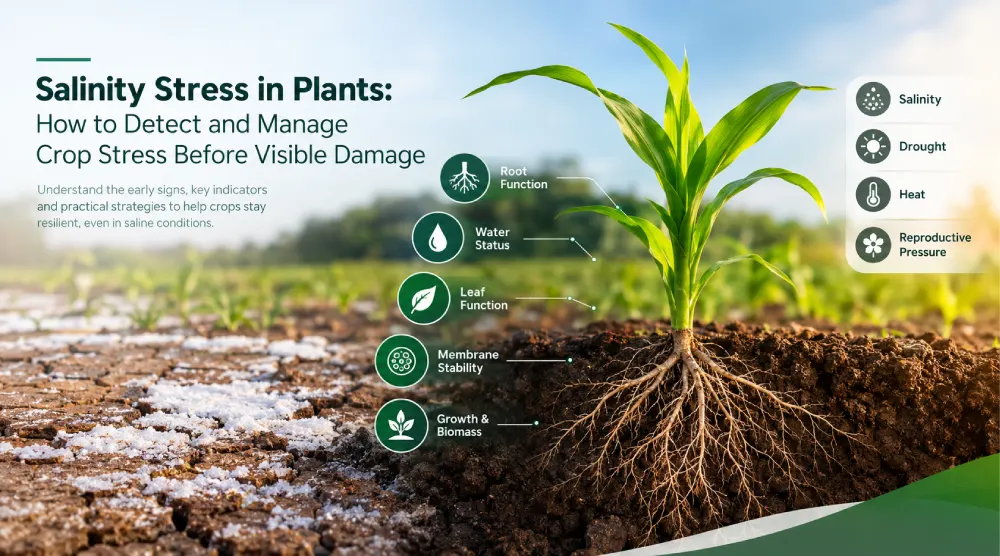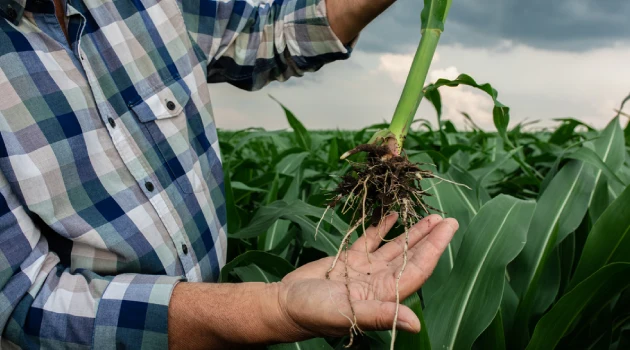
The crop starts before the crop is visible.
Before the first strong canopy appears, before flowering begins, before yield is formed, one system is already shaping the crop’s future: its root system.
Root architecture is one of the earliest foundations of crop performance. It determines how a crop anchors, explores the soil, accesses water, captures nutrients, and supports early development.
In agriculture, we often judge crop health by what we see above the soil — plant height, leaf colour, canopy size, flowering. But many performance limitations begin below the surface, in the rhizosphere, well before the crop gives any visible signal.
A weak root system may not immediately look like a problem. Over time, though, it affects establishment, nutrient uptake in plants, water movement, canopy development, and crop uniformity.
Root architecture is not just a root-growth topic. It is the crop’s first performance infrastructure.
Why this matters now
Soil compaction is increasing. Soil biology is declining in many systems. Rainfall is more erratic, heat stress is more frequent, and input costs keep rising.
In this environment, a crop that establishes strong roots early has a real advantage — better nutrient efficiency, more consistent stands, and faster recovery from stress. Root system development is no longer a background factor. It is becoming a first-line defense against an increasingly unpredictable growing environment.
More than root length
Root architecture refers to the structure, spread, and balance of the entire below-ground system.
It includes the primary root system, feeder roots, secondary and tertiary root formation, root biomass, root volume, and the balance between root and shoot growth. Together, these form the core root development parameters used to evaluate below-ground health.
Each parameter tells a different part of the story:
| Parameter | What it helps explain |
| Root length | Soil exploration and access |
| Root volume | Active root-zone development |
| Root biomass | Strength of below-ground foundation |
| Secondary and tertiary roots | Feeder-root network expansion |
| Root-to-shoot ratio | Balance between root and canopy development |
| Germination speed | Early establishment momentum |
| Seedling vigour | Uniformity and early crop strength |
| Tissue NPK | Nutrient capture and movement |
| SPAD / NDVI | Canopy-linked performance signals |
The hidden foundation of crop performance
Every visible crop outcome has a below-ground foundation.
Canopy growth needs root support. Nutrient response depends on efficient nutrient capture. Water movement needs root exploration. Early uniformity needs a balanced root-to-shoot ratio.
Better roots are not just about more growth. They are about better nutrient capture, stronger crop uniformity, and improved stress recovery.
The conversation should not stop at “better roots.” It should ask: what kind of roots, how are they measured, and how do they support early crop establishment?
When root system development is framed through measurable parameters, the claim becomes more credible — and more useful to agronomists, formulators, and growers alike.
RaizUp: build the crop from below
RaizUp is the UpCrop pillar focused on root architecture, early crop establishment, rhizosphere activity, and nutrient capture.
Its role is to move the conversation from generic rooting claims toward measurable crop root development.
RaizUp brings together root length, root volume, root biomass, root-to-shoot ratio, germination speed, seedling vigour, and nutrient-capture parameters into one integrated root-performance framework.
The idea is simple: the crop starts before the crop is visible. Build the crop from below.
Conclusion
Root architecture is not a secondary growth feature. It is one of the earliest systems shaping crop establishment, nutrient capture, water access, and canopy development.
For biological input programs, the future of rooting claims will depend on measurable root system development and clearly defined root development parameters — not broad growth language alone.
RaizUp places root architecture at the centre of early crop performance.
The crop starts before the crop is visible.
Ready to build a differentiated biological portfolio around root architecture and early establishment?
Trishul Biotech partners with agri-input companies through B2B, white-label, and custom formulation programs under the UpCrop platform.
Talk to our team to explore RaizUp-based formulation and technical collaboration opportunities.